Heritage Day: From Shaka Day to Braai Day
Before 1995, 24 September was Shaka Day in KwaZulu-Natal. How it became Heritage Day, then Braai Day for some, is a story about compromise.
Ask South Africans what 24 September is for and you will get different answers. Heritage Day. Shaka Day. Braai Day. Each answer carries a piece of history, and a language. The story of how Heritage Day got its date and its names is a story about compromise, told here with a few isiZulu and Afrikaans words along the way.
Shaka Day in KwaZulu-Natal
In KwaZulu-Natal, 24 September was observed as Shaka’s Day, commemorating King Shaka. IOL explains that the day has its roots in the apartheid era, when the KwaZulu homeland government under Prince Mangosuthu Buthelezi began it. The KwaZulu-Natal government records that King Shaka was assassinated on 24 September 1828 at his KwaDukuza palace.
That commemoration continues. In 2024 the provincial government reported on Umkhosi WeLembe, the annual King Shaka commemoration held in KwaDukuza on 24 September.
Why is Heritage Day on 24 September?
When democratic South Africa drew up its new calendar of public holidays, the Public Holidays Act of 1994, the draft omitted Shaka Day. South African History Online recounts that the Inkatha Freedom Party objected, and “a compromise was reached when it was decided to create a day where all South Africans could observe and celebrate their diverse cultural heritage.” The first Heritage Day was celebrated on 24 September 1995.
In 1996 President Nelson Mandela explained the thinking: “our rich and varied cultural heritage has a profound power to help build our new nation.”
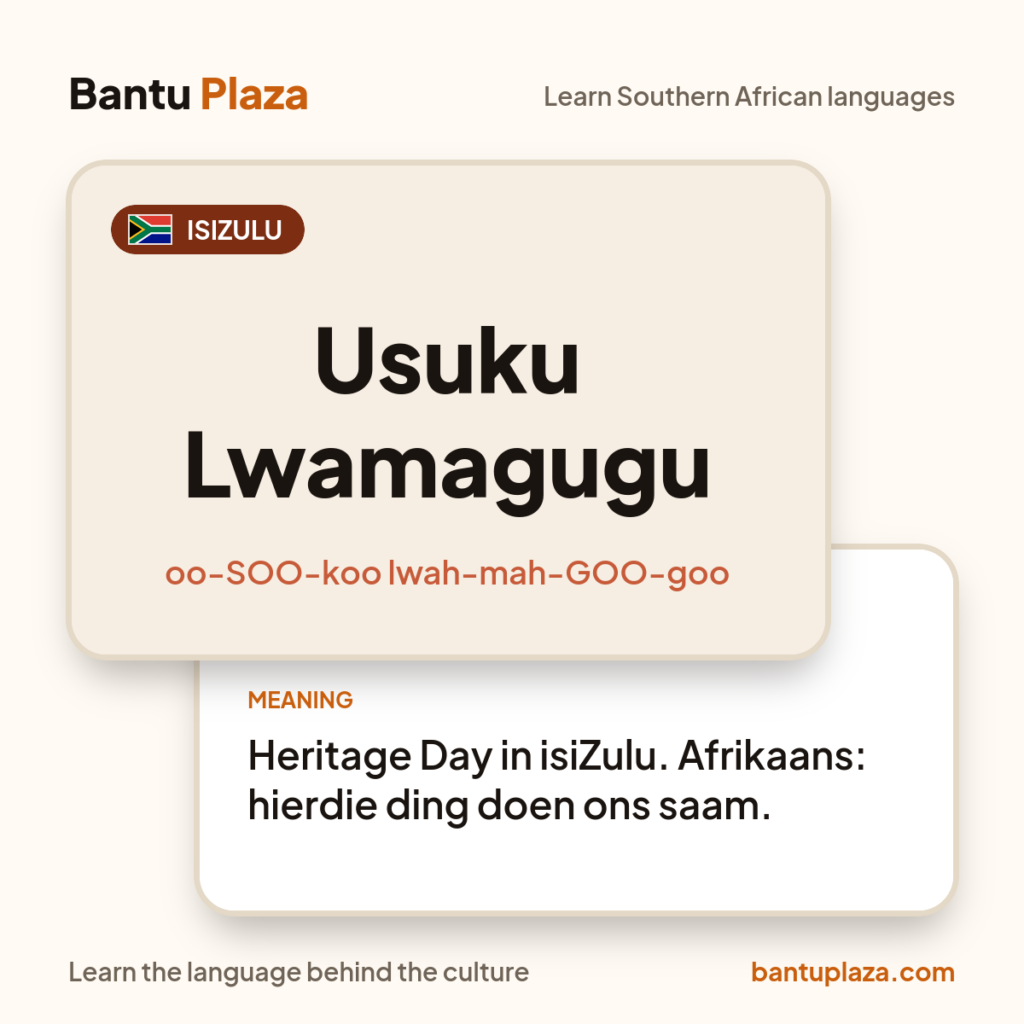
In isiZulu, Heritage Day is Usuku Lwamagugu, a phrase used in KwaZulu-Natal government programmes.
How Braai Day began
Then came the fire. In 2005 Jan Scannell, known as Jan Braai, launched a campaign to celebrate the day around a braai. Its website states that it has “inspired millions of South Africans to unite around fires on 24 September every year”. SAHO records that Archbishop Desmond Tutu became the campaign’s national spokesperson in 2007, and that the National Heritage Council, after first dismissing the idea as trivialising, endorsed it in 2008.
Tutu’s argument was about shared language. SAHO quotes him saying South Africa had “11 different official languages but only one word for the wonderful institution of braai”, and summing it up in Afrikaans: hierdie ding doen ons saam, this thing we do together.
Whose heritage?
Not everyone welcomed Braai Day. Research by Elize Joubert, summarised by The Heritage Portal, found it split opinion into supporters, opponents and the indifferent. Critics have seen it as trivialising or commercialising a day meant for deeper reflection. Both things can be true: the braai is shared, and heritage is bigger than any one meal.
Quick facts
- Before Heritage Day, 24 September was observed in KwaZulu-Natal as Shaka’s Day, commemorating King Shaka.
- The draft of the Public Holidays Act of 1994 omitted Shaka Day; after the Inkatha Freedom Party objected, a compromise created Heritage Day.
- The first Heritage Day was celebrated on 24 September 1995.
- Jan Scannell launched the Braai Day campaign in 2005; Archbishop Desmond Tutu became its spokesperson in 2007.
- Umkhosi WeLembe, the annual King Shaka commemoration, is still held in KwaDukuza on 24 September.
Words to know
| Word or phrase | Meaning | Say it like |
|---|---|---|
| Usuku Lwamagugu (isiZulu) | Heritage Day | oo-SOO-koo lwah-mah-GOO-goo |
| Ifa lethu (isiZulu) | our heritage, inheritance | EE-fah LEH-too |
| umlando (isiZulu) | history | oom-LAHN-doh |
| inyama (isiZulu) | meat | ee-NYAH-mah |
| die erfenis (Afrikaans) | the heritage | dee ER-fe-nis |
| braai (Afrikaans) | barbecue, a cookout get-together; also the verb, to grill | br-eye |
| hierdie ding doen ons saam (Afrikaans) | this thing we do together | HEER-dee ding doon ons sahm |
The pronunciations are guides. Listening to the words spoken is the fastest way to get them right.
In everyday conversation
A 24 September gathering starts the way any visit does, with a greeting:
- Sawubona, mama. Unjani? Hello, ma’am. How are you? (isiZulu)
- Ngiyaphila, baba. Wena unjani? I’m well, sir. And you? (isiZulu)
- Kom braai! Come hang out over a braai. (Afrikaans)
- Baie dankie. Thank you very much. (Afrikaans)
Frequently asked questions
Why is Heritage Day celebrated on 24 September?
24 September had been observed in KwaZulu-Natal as Shaka’s Day. When the 1994 draft of public holidays left it out, a compromise created a day for all South Africans to celebrate their diverse cultural heritage, first held on 24 September 1995.
Why is Heritage Day called Braai Day?
In 2005 Jan Scannell launched a campaign to celebrate the day around a braai. Archbishop Desmond Tutu became its spokesperson in 2007, and the National Heritage Council endorsed it in 2008, though opinion on the idea remains split.
What is Heritage Day in isiZulu?
Heritage Day in isiZulu is Usuku Lwamagugu, a phrase used in KwaZulu-Natal government programmes. Say it like oo-SOO-koo lwah-mah-GOO-goo.
Your 24 September
What does 24 September mean in your home: Shaka Day, Heritage Day, Braai Day, or something else entirely? For the full background, read South African History Online on Heritage Day, Braai Day and Shaka Day. For another harvest-season tradition, read our story on Dikgafela in Botswana.
Our isiZulu hub brings the lessons, the isiZulu: Complete Language Pack (A1 to C2) and the culture stories together. To hear these words spoken, start a free 5-minute isiZulu lesson or book a trial with an isiZulu tutor.
Sources
Quick check
Did you already know the word "Usuku Lwamagugu"?
Usuku Lwamagugu oo-SOO-koo lwah-mah-GOO-goo
Heritage Day in isiZulu. Afrikaans: hierdie ding doen ons saam.
Learn more isiZulu words freeWant to understand more than the translation?
Learn the language behind the culture.
Newsletter
Get one culture story a week
New stories, a word to try and a free lesson idea. No spam, unsubscribe anytime.

Join the conversation
Question for you What does 24 September mean in your home: Shaka Day, Heritage Day, Braai Day, or something else entirely?
Do you know this tradition, a different version of it, or the word for it in another language? Share it below.