Dikgafela: Bringing the Harvest to the Kgosi
When the harvest is good, communities in Botswana carry baskets of sorghum to the kgosi. Dikgafela gives thanks, asks for rain and fills the granary.
Before dawn in Kanye, a chief’s official climbs a hill and calls out towards the village wards: Dikgafela, tseo a ditle, bring the Dikgafela. Later that morning, married women arrive carrying baskets of sorghum on their heads. This is Dikgafela, the harvest tribute that Batswana communities bring to the kgosi after a good season, and one of the oldest harvest traditions in Botswana.
What is Dikgafela?
Margaret Sheppard, who carried out fieldwork in Kanye among the Bangwaketse between 1977 and 1983, describes Dikgafela as having several purposes at once: “to give thanks for the last harvest”, “to help bring the Rains for the new growing season”, and to “collect a store of sorghum that can be distributed to the needy in the case of food shortages or famine.”
That last purpose is practical and important. Traditionally, Sheppard writes, the mabele (sorghum) brought during Dikgafela “was stored in the tribal granaries, and then when families’ crops failed they could buy it cheaply to feed their families.” The festival linked each household’s good year to the whole community’s bad ones.
Dikgafela, rain and the Badimo
The religious dimension is part of it too. If the Badimo, the ancestors, are pleased, the belief is that they will ensure good rain. In Sheppard’s account from Kanye, the Badimo are pleased because the beer brewed from the sorghum is shared freely, and the rain they send lets people plough and gives the livestock water and grazing.
She also describes branches of the moologa tree placed on top of the baskets, a wish that last year’s mabele will not run out before the new crop is harvested. People are “beaten” lightly with these branches while the crowd shouts Pula!, a call for rain.
How the Dikgafela ceremony worked in Kanye
In Kanye, every married woman from each kgotla, or ward, was expected to take a basketful of sorghum to the chief’s kgotla. After brewing beer, the women brought a sample to be drunk at the chief’s kgotla, then returned to finish the rest over the following days in their own wards. People were not supposed to leave for their lands until the ceremony had been held.
Taking part was not optional. Sheppard notes that a ward which failed to organise its contribution was fined a head of cattle, which was slaughtered at the chief’s kgotla and eaten by those present.
Only when the harvest allows
Dikgafela is not held on a fixed date. Sheppard notes it is annual “except after a bad harvest”, and during her six years of fieldwork it happened only three times because the rains failed. In Kanye she recorded it as usually held in September, and describes its revival around 1970 by Kgosi Seepapitso IV after several years without it.
Other communities choose their own timing. Botswana’s Daily News reported Batlokwa wards presenting their harvest to Kgosi Puso Gaborone in Tlokweng in June 2023, where he noted that in Setlokwa the festival is called molomo. In August 2025 the paper reported a revival in Ranaka, with maize, beans and sorghum gathered and stored in difalana, communal granaries, under the chief’s supervision. Organisers said drought and climate change had nearly halted the tradition, and framed the revival as a way to teach young people their heritage. Today the crops and ceremonies vary from one morafe to the next.
Quick facts
- Dikgafela is a harvest tribute brought to the kgosi: thanks for the harvest, a call for rain and a food store for hard years.
- In Kanye it was usually held in September, but only after a good harvest.
- Sorghum (mabele) went into tribal granaries and was sold cheaply to families whose crops failed.
- Kgosi Seepapitso IV revived it in Kanye around 1970.
- Tlokweng held its harvest presentation in June 2023, and Ranaka revived the tradition in August 2025.
Words to know
| Setswana | Meaning | Say it like |
|---|---|---|
| Dikgafela | the harvest tribute to the kgosi | dee-khah-FEH-lah |
| mabele | sorghum | mah-BEH-leh |
| Kgosi | chief | KHOH-see |
| Kgotla | the chief’s court, the community meeting place | KHOH-tlah |
| Pula | rain; also a cry of blessing | POO-lah |
| Letlhafula | autumn, the harvest season | leh-tlhah-FOO-lah |
| motse | village, town | MOH-tseh |
The “kg” sound is made at the back of the throat with a breathy rasp, so Kgosi starts with a “kh”, never a hard English “g”.
In everyday conversation
At any gathering, the respectful greeting comes first:
- Dumela, mma. O kae? Hello, ma’am. How are you?
- Ke teng, rra. Wena o kae? I’m well, sir. And you?
- Ke a leboga thata. Thank you very much.
And when a speech ends well, the crowd answers with Pula!
Frequently asked questions
What is Dikgafela in Botswana?
Dikgafela is a Setswana harvest tribute in which communities bring part of their harvest, traditionally sorghum, to the kgosi. It gives thanks for the harvest, asks for rain and stores food for families in hard years.
When is Dikgafela held?
There is no fixed date. In Kanye it was usually held in September and only after a good harvest, while Tlokweng held its presentation in June 2023 and Ranaka in August 2025.
Why do people shout Pula at Dikgafela?
Pula means rain. In Sheppard’s account from Kanye, people are tapped with moologa branches while the crowd shouts Pula to call the rain for the new season.
Your village
Does your morafe still hold Dikgafela, and in which month? What crops do people bring? You can read more stories from Botswana in our Setswana culture stories, or read Margaret Sheppard’s notes on Dikgafela in full.
Our Setswana hub has lessons at every level, including the culture vocabulary of the kgotla, and the Setswana Complete Language Pack takes you from A1 to C2. If you would like to hear these words spoken, start a free 5-minute Setswana lesson or book a trial with a Setswana tutor.
Quick check
Did you already know the word "Dikgafela"?
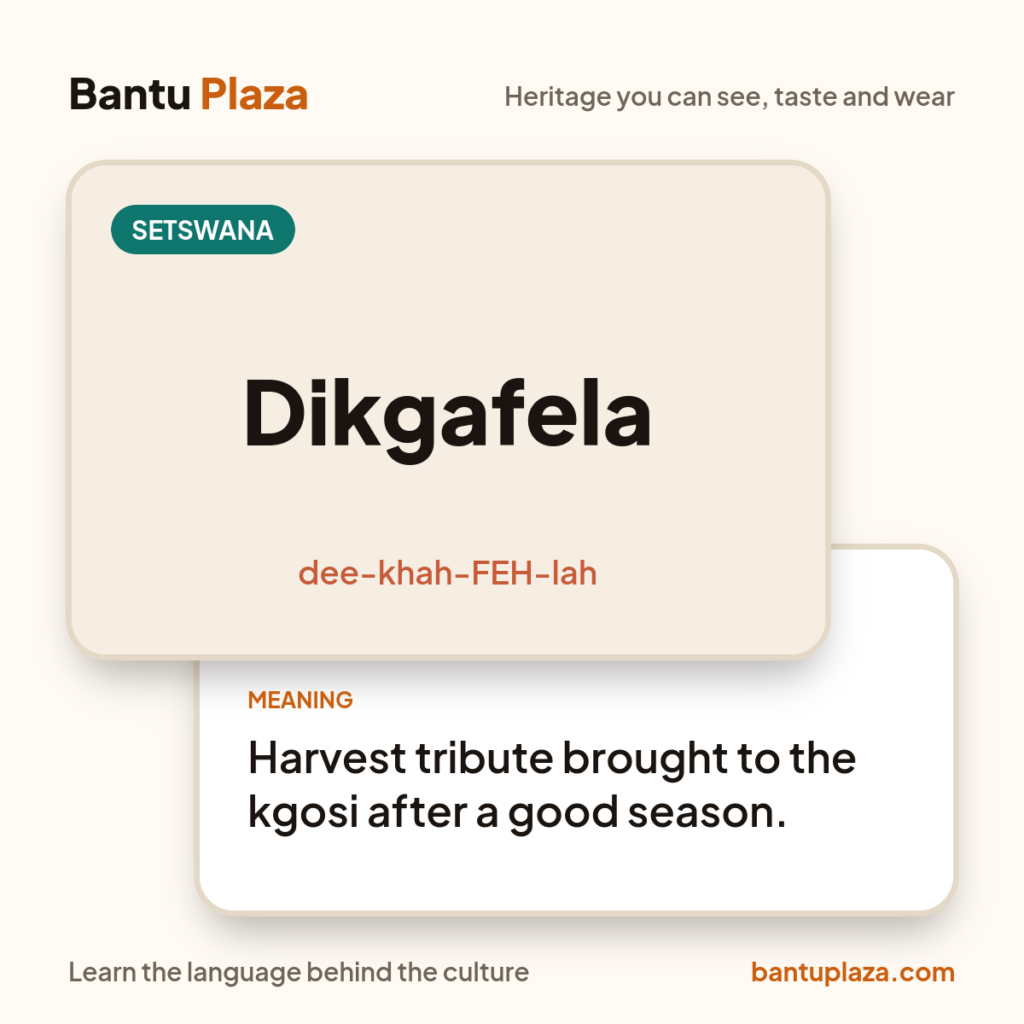
Dikgafela dee-khah-FEH-lah
Harvest tribute brought to the kgosi after a good season.
Learn more Setswana words freeWant to understand more than the translation?
Learn the language behind the culture.
Newsletter
Get one culture story a week
New stories, a word to try and a free lesson idea. No spam, unsubscribe anytime.
Join the conversation
Question for you Does your morafe still hold Dikgafela, and in which month?
Do you know this tradition, a different version of it, or the word for it in another language? Share it below.