Town Nyanja: How Lusaka Made a Language Its Own
The Nyanja you hear on a Lusaka minibus is not quite the Nyanja in the textbook. Meet Town Nyanja, the city's everyday lingua franca.
Stand at a Lusaka bus stop for ten minutes and you will hear a lot of languages. You will also hear one that ties them together. People from different language backgrounds who move to Zambia’s capital often end up talking to each other in Nyanja, and not always the textbook version. Our course calls it Town Nyanja.
A lingua franca for a capital city
Zambia recognises seven regional languages for official purposes: Bemba, Nyanja, Lozi, Tonga, Kaonde, Luvale and Lunda. A presentation by Joseph Mwansa of the University of Zambia links Nyanja to Lusaka and Eastern Province. The language data organisation CLEAR Global notes that the 2010 census records over 30 major languages in the country, so a shared language matters.
CLEAR Global describes an urban variety of Nyanja as the lingua franca of Lusaka, used for communication between speakers of different languages, and notes that Nyanja is also widely spoken as a second language across Zambia. Bemba, the country’s largest indigenous language, also serves as a lingua franca in some areas, and English, the official language, is the most commonly used second language.
A lingua franca belongs to everyone who uses it, and city speakers shape it to fit city life. That is where Town Nyanja comes from.
What is Town Nyanja?
Town Nyanja is the everyday Nyanja of Lusaka’s streets. Bantu Plaza’s Nyanja course teaches forms that are understood everywhere in Zambia, and our course notes point out a few things you will hear in the city:
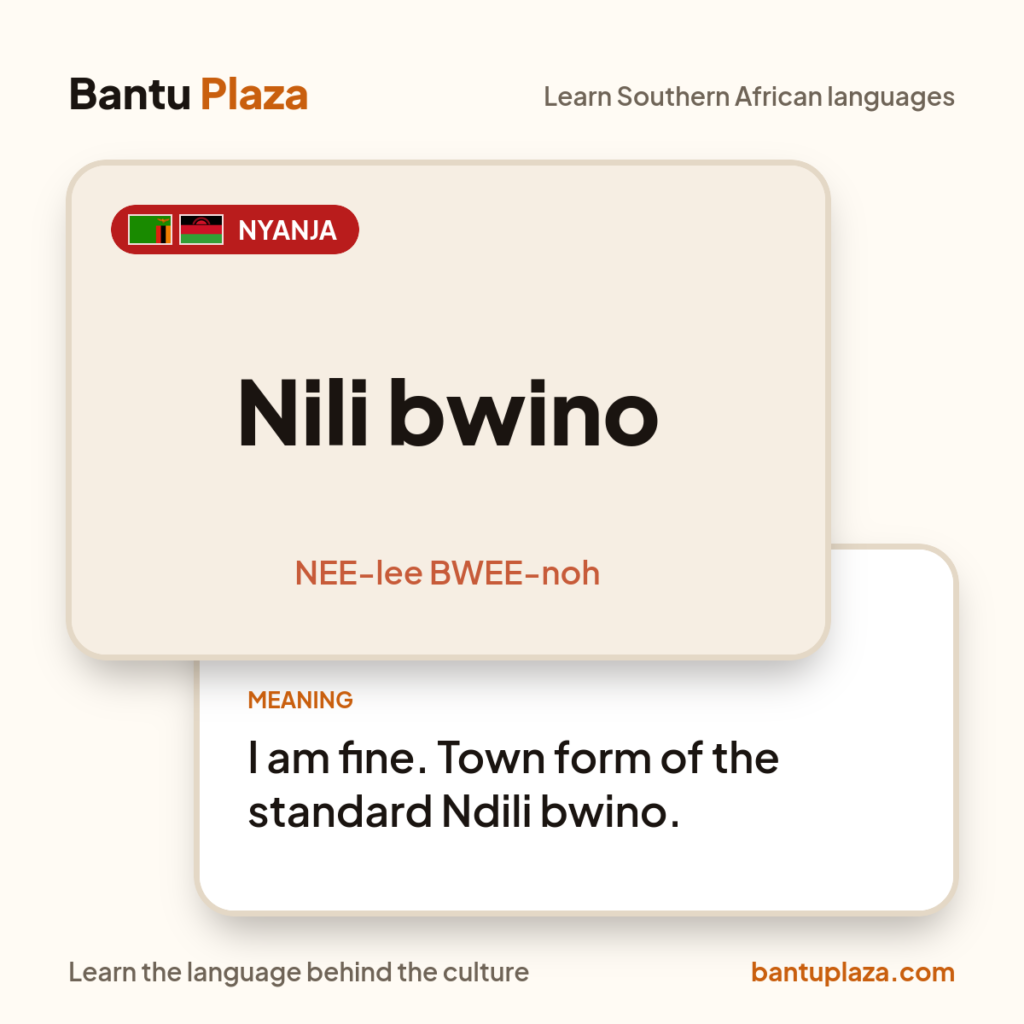
- “I” becomes ni- instead of ndi-. The standard Ndili bwino (I am fine) is often Nili bwino in town. Ndimachokera (I come from) can become Nimachokera.
- “They” can be ba- rather than the standard a-.
- English words move in. buledi (bread) and tiyi (tea) are borrowings, and in everyday Lusaka speech people very often use English numbers and English day names.
None of this is “wrong”. It is what happens when a language becomes the shared property of a big, mixed city. The standard forms remain understood, and the town forms tell people you have spent time in Lusaka.
Numbers and days, the textbook way
Even if you hear “Monday” and “twenty” in town, the Nyanja forms are worth knowing. The bare counting words start modzi, wiri, tatu (one, two, three), and six to nine are built as “five and …”. Most weekday names are built from numbers too: Lachiwiri is “the second day”, Tuesday, while Monday (Lolemba) and Saturday (Loweruka) have their own names.
Zambia and Malawi, side by side
Cross the border to Malawi, where the language is called Chichewa, and you will meet other differences. One example from our course: Zambian Nyanja uses -na- for the past, as in ndinapita (I went), while -da- is the Malawian Chichewa form.
Quick facts
- Nyanja is one of Zambia’s seven official regional languages, associated with Lusaka and Eastern Province.
- An urban variety of Nyanja is the lingua franca of Lusaka.
- In Town Nyanja, Ndili bwino often becomes Nili bwino.
- English numbers and day names are very common in everyday Lusaka speech.
- Zambian Nyanja marks the past with -na-, Malawian Chichewa with -da-.
Words to know
| Chichewa / Nyanja | Meaning | Say it like |
|---|---|---|
| Muli bwanji? | how are you? | MOO-lee BWAHN-jee |
| Ndili bwino / Nili bwino | I am fine (standard / town) | n-DEE-lee BWEE-noh / NEE-lee BWEE-noh |
| Zikomo | thank you, also excuse me | zee-KOH-moh |
| Ndi zingati? | how much is it? | ndee zeen-GAH-tee |
| msika | market | m-SEE-kah |
| ndalama | money | n-dah-LAH-mah |
| buledi | bread | boo-LEH-dee |
| tiyi | tea | TEE-yee |
In everyday conversation
A simple market visit in Lusaka might go like this:
- Moni! Muli bwanji? Hello! How are you?
- Ndikufuna kugula … I want to buy …
- Ndi zingati? How much is it?
- Zikomo kwambiri. Thank you very much.
Frequently asked questions
What language is spoken in Lusaka?
Many languages are spoken in Lusaka, but CLEAR Global describes an urban variety of Nyanja as the city’s lingua franca, used between speakers of different languages. English is Zambia’s official language.
How is Town Nyanja different from standard Nyanja?
Town Nyanja often uses ni- instead of ndi- for “I” (Nili bwino for Ndili bwino) and ba- for “they”, and speakers mix in English numbers and day names. The standard forms are still understood everywhere in Zambia.
Lusaka speakers, help us out
What is one Town Nyanja word or phrase that a textbook would never teach you, and what does it mean? For the bigger picture, see CLEAR Global’s language data for Zambia, or read our story on why Chichewa and Nyanja are one language with different names.
Our Chichewa / Nyanja hub collects the lessons, and the Chichewa / Nyanja: Starter Pack (A1) covers numbers, days and market words. Learn the standard forms first: start the free 5-minute Chichewa / Nyanja lesson, then listen for the town versions when you visit.
Quick check
Did you already know the word "Nili bwino"?
Nili bwino NEE-lee BWEE-noh
I am fine. Town form of the standard Ndili bwino.
Learn more Nyanja words freeWant to understand more than the translation?
Learn the language behind the culture.
Newsletter
Get one culture story a week
New stories, a word to try and a free lesson idea. No spam, unsubscribe anytime.

Join the conversation
Question for you What is one Town Nyanja word or phrase that a textbook would never teach you, and what does it mean?
Do you know this tradition, a different version of it, or the word for it in another language? Share it below.