Sepedi or Sesotho sa Leboa? The Two Names of One Official Language
South Africa's Constitution says Sepedi. Many universities and speakers say Sesotho sa Leboa. Why one official language has two names.
Open South Africa’s Constitution in English and you will find Sepedi listed among the official languages. Walk into a university language department in Limpopo or Gauteng and you may see the same language called Sesotho sa Leboa, or Northern Sotho. Are these different languages? No. Is the naming question settled? Also no.
Is Sesotho sa Leboa the same as Sepedi?
Yes. A 2021 study in the journal Literator by T.J. Rakgogo and E.B. Zungu notes that three names, Sepedi, Sesotho sa Leboa and Northern Sotho, are all used in official documents to refer to one and the same language. Our lessons explain that Sesotho sa Leboa means “Sotho of the North”, and that strictly speaking Sepedi is the dialect of the Pedi people, the Bapedi, while the name is also widely used for the standard written language.
How the two names arose
Rakgogo and Zungu set out the history. South Africa’s interim Constitution of 1993 designated Sesotho sa Leboa as one of the proposed official languages. The final Constitution of 1996, in section 6(1), lists Sepedi instead. Since then both names, along with Northern Sotho, have appeared in official documentation.
Why the name matters to speakers
The study describes speakers as divided into two broad groups. For some, Sepedi is the right name. Some in this group see “Northern Sotho” as a colonial-era label, and say they cannot identify with a name created by the coloniser.
Others argue that Sepedi is the name of one variety, associated with the Bapedi, and that the wider standard language, which draws on many varieties, should be called Sesotho sa Leboa. Some in this group also say the process of replacing Sesotho sa Leboa with Sepedi was not consultative and transparent.
The authors report that research by an ad hoc committee of the Pan South African Language Board found about two-thirds of respondents preferred Sesotho sa Leboa, and about a third preferred Sepedi. The matter has come up in Parliament’s Joint Constitutional Review Committee more than once, including in 2017 and 2020.
How big is the language?
Whatever you call it, it is one of South Africa’s largest. Census 2022 found it is the language spoken most often at home by 10.0% of South Africans, and by 55.5% of people in Limpopo. It is also spoken in Mpumalanga and Gauteng, and it belongs to the Sotho-Tswana family, so learners of Setswana or Sesotho will recognise many words.
What we do on Bantu Plaza
Our course and pages use Sepedi, the constitutional name, and we describe the language as “Sepedi (Northern Sotho, or Sesotho sa Leboa)” so every speaker can find it. We know some speakers prefer another name, and we respect that.
Words to know
| Sepedi | Meaning | Say it like |
|---|---|---|
| Sepedi | the language, also called Sesotho sa Leboa | seh-PEH-dee |
| Bapedi | the Pedi people | bah-PEH-dee |
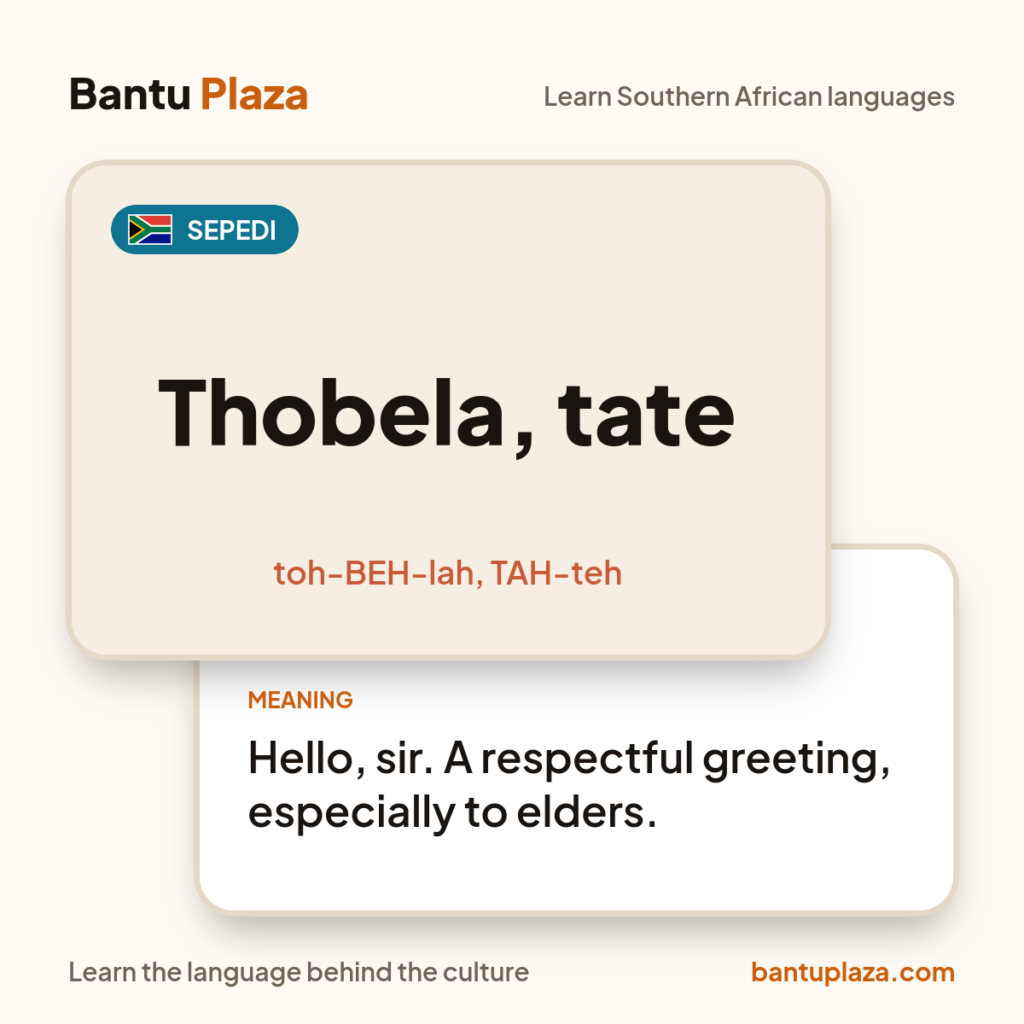
| Thobela | hello (respectful, especially to elders) | toh-BEH-lah |
| Dumelang | hello (polite, to one person or many) | doo-meh-LAHNG |
| tate | father; a title for an older man | TAH-teh |
| mma | mother; a title for an older woman | MMAH |
| Ke ithuta Sepedi | I am learning Sepedi | keh ee-THOO-tah seh-PEH-dee |
A greeting that works under any name
Thobela is a respectful greeting, especially to elders. Pair it with a title: Thobela, tate (to a man) or Thobela, mma (to a woman). For everyday use, Dumelang is polite to one person or many. A short exchange might go:
- Dumelang! Le kae? Hello! How are you? (leh KAH-eh)
- Re gona, ke a leboga. We are fine, thank you. (reh GHOH-nah, keh ah leh-BOH-ghah)
- Ke ithuta Sepedi. I am learning Sepedi.
Quick facts
- Sepedi, Sesotho sa Leboa and Northern Sotho are three names for one language.
- The 1993 interim Constitution used Sesotho sa Leboa; the 1996 Constitution, section 6(1), lists Sepedi.
- A PanSALB ad hoc committee found about two-thirds of respondents preferred Sesotho sa Leboa.
- Census 2022: 10.0% of South Africans speak it most often at home, and 55.5% of people in Limpopo.
Frequently asked questions
Is Sepedi the same as Sesotho sa Leboa?
Yes. Sepedi, Sesotho sa Leboa and Northern Sotho are all used in official documents for one and the same language. Some speakers use Sepedi for the Pedi variety and Sesotho sa Leboa for the wider standard language.
What does Sesotho sa Leboa mean?
It means “Sotho of the North”. In English the language is often called Northern Sotho.
Why does the Constitution say Sepedi?
The interim Constitution of 1993 named Sesotho sa Leboa, but section 6(1) of the final 1996 Constitution lists Sepedi. The choice is still debated, including in Parliament’s Joint Constitutional Review Committee.
What do you call it?
If this is your language, which name do you use, Sepedi, Sesotho sa Leboa or Northern Sotho, and why? Read Rakgogo and Zungu’s study in Literator for the full debate, and see how the language compares with its neighbours in Sesotho, Setswana and Sepedi: how close are they?
Explore more on our Sepedi language page, where the Sepedi Starter Pack covers greetings, family and everyday phrases. The easiest place to begin is a free 5-minute Sepedi lesson.
Quick check
Did you already know the word "Thobela, tate"?
Thobela, tate toh-BEH-lah, TAH-teh
Hello, sir. A respectful greeting, especially to elders.
Learn more Sepedi words freeWant to understand more than the translation?
Learn the language behind the culture.
Newsletter
Get one culture story a week
New stories, a word to try and a free lesson idea. No spam, unsubscribe anytime.

Join the conversation
Question for you If this is your language, which name do you use, Sepedi, Sesotho sa Leboa or Northern Sotho, and why?
Do you know this tradition, a different version of it, or the word for it in another language? Share it below.