How to Say “Water” in 13 Southern African Languages
Metsi, amanzi, mvura, madzi, maasi. One everyday word in thirteen Southern African languages, with a say-it-like guide for each.
Water is the first word many of us learn to ask for, and the one you will need on your first day anywhere in Southern Africa. Here is how to say water in thirteen languages taught on Bantu Plaza, with a say-it-like guide for each, and what the words tell you about how closely these languages sit together.
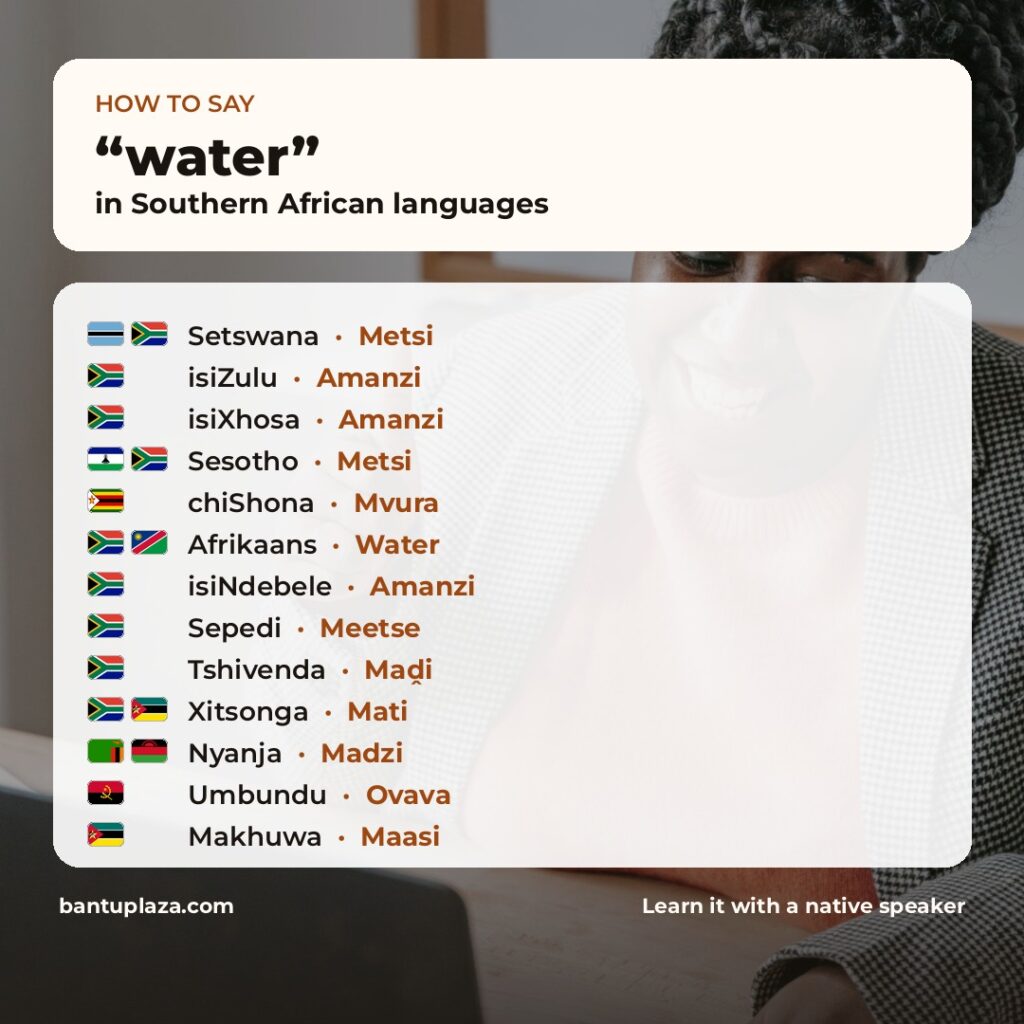
How to say water in thirteen Southern African languages
| Language | Water | Say it like |
|---|---|---|
| Setswana | metsi | MET-see |
| isiZulu | amanzi | ah-MAHN-zee |
| isiXhosa | amanzi | ah-MAHN-zee |
| Sesotho | metsi | MEH-tsee |
| chiShona | mvura | MVOO-rah |
| Afrikaans | water | VAH-ter |
| isiNdebele | amanzi | ah-MAH-nzee |
| Sepedi | meetse | meh-EH-tseh |
| Tshivenda | maḏi | MAH-dee |
| Xitsonga | mati | MAH-ti |
| Nyanja | madzi | MAH-dzee |
| Umbundu | ovava | oh-VAH-vah |
| Makhuwa | maasi | MAAH-see |
One word, two families
Read the list aloud and you can hear the languages group themselves. Metsi, meetse and maḏi sit together. Madzi, mati and maasi are clearly cousins of the same word. Amanzi holds firm across isiZulu, isiXhosa and isiNdebele. chiShona goes its own way with mvura, and Umbundu, spoken far up in Angola, has ovava.
Afrikaans is the outlier on the list: water is written exactly as in English, but the w is said like a v, so it comes out VAH-ter.
Asking for water politely
In most of these languages you soften a request with a please word rather than a whole polite sentence. In Setswana, Ke kopa metsi is I am asking for water. In isiZulu, Ngicela amanzi does the same job, and ngicela is worth learning on its own: it turns almost anything into a polite request.
How do you say water in Zulu?
Water in isiZulu is amanzi, said ah-MAHN-zee. The same word is used in isiXhosa and isiNdebele.
How do you say water in Setswana?
Water in Setswana is metsi, said MET-see. Sesotho uses the same word, and Sepedi says meetse.
Why is water amanzi in some languages and metsi in others?
The Nguni languages (isiZulu, isiXhosa, isiNdebele, siSwati) and the Sotho-Tswana languages (Setswana, Sesotho, Sepedi) are separate branches of the same family. Everyday words like water often stay close inside a branch and differ between branches.
Over to you
Which word did you grow up asking for? Every active language on this list has a free five-minute lesson you can try right now, with no account: Setswana, isiZulu, isiXhosa, Sesotho, chiShona, Afrikaans and Ikalanga.
When you want to use these words with a real person, find a native-speaker tutor for a 45-minute lesson, or learn at your own pace with Teach Yourself, one level at a time.
Want to understand more than the translation?
Learn the language behind the culture.
Newsletter
Get one culture story a week
New stories, a word to try and a free lesson idea. No spam, unsubscribe anytime.
Join the conversation
Question for you Which word did you grow up asking for?
Do you know this tradition, a different version of it, or the word for it in another language? Share it below.