Myth vs Fact: Who Speaks Afrikaans at Home?
Census 2022 data challenges three common assumptions about Afrikaans: who speaks it, where, and whether it is shrinking.
Afrikaans comes with a lot of assumptions attached, and some are decades out of date. So who speaks Afrikaans at home in South Africa today? Statistics South Africa’s Census 2022 reports let us check three common beliefs against the numbers. All figures below are for the language spoken most often at home.
Who speaks Afrikaans at home? Three myths, three facts
The census data challenges three ideas you still hear: that Afrikaans belongs mainly to one group, that it is dying out, and that it is a Western Cape language. Here is what the numbers say.
Myth 1: Afrikaans is mainly a white South African language
Fact: Stats SA’s Cultural Dynamics in South Africa report shows that 72.6% of coloured South Africans speak Afrikaans most often at home, compared with 58.0% of white South Africans.
Population size matters too. In Census 2022, coloured South Africans made up 8.2% of the population and white South Africans 7.3%. Doing the arithmetic on a population of about 62 million gives roughly 3.7 million coloured Afrikaans home speakers and roughly 2.6 million white Afrikaans home speakers. These are our estimates from the published percentages, but the direction is clear: the largest group of Afrikaans home speakers is coloured South Africans.
Myth 2: Afrikaans is dying out
Fact: The picture is more mixed than that. Afrikaans’ share fell from 14.5% in 1996 to 10.6% in 2022. But Stats SA points out that the actual number of Afrikaans speakers increased by more than 700,000 people over the same period, because the population grew. It is still the third most spoken home language in South Africa, after isiZulu and isiXhosa.
Myth 3: Afrikaans is a Western Cape language
Fact: The Western Cape has a large Afrikaans-speaking population, 41.2% of households. But the province with the highest share is the Northern Cape, where 54.6% of people speak Afrikaans most often at home. There are sizeable Afrikaans-speaking communities in the Eastern Cape (9.6%), Free State (10.3%) and Gauteng (7.7%) as well.
Why this matters
When we picture a language as belonging to one group, we stop seeing most of the people who speak it. The census reminds us that Afrikaans is a shared South African language with many communities, histories and accents. Our Afrikaans lessons make the same point: Afrikaans grew from 17th-century Dutch in the mouths of Khoi, slave, settler and farming communities, and varieties such as Kaaps are a celebrated literary voice today.
Quick facts
- 72.6% of coloured South Africans and 58.0% of white South Africans speak Afrikaans most often at home (Census 2022).
- Afrikaans’ share of home speakers fell from 14.5% in 1996 to 10.6% in 2022, but the number of speakers grew by more than 700,000.
- It is South Africa’s third most spoken home language, after isiZulu and isiXhosa.
- The Northern Cape has the highest share of Afrikaans home speakers, at 54.6%.
Words to know
| Afrikaans | Meaning | Say it like |
|---|---|---|
| Hallo | hello | hah-LOH |
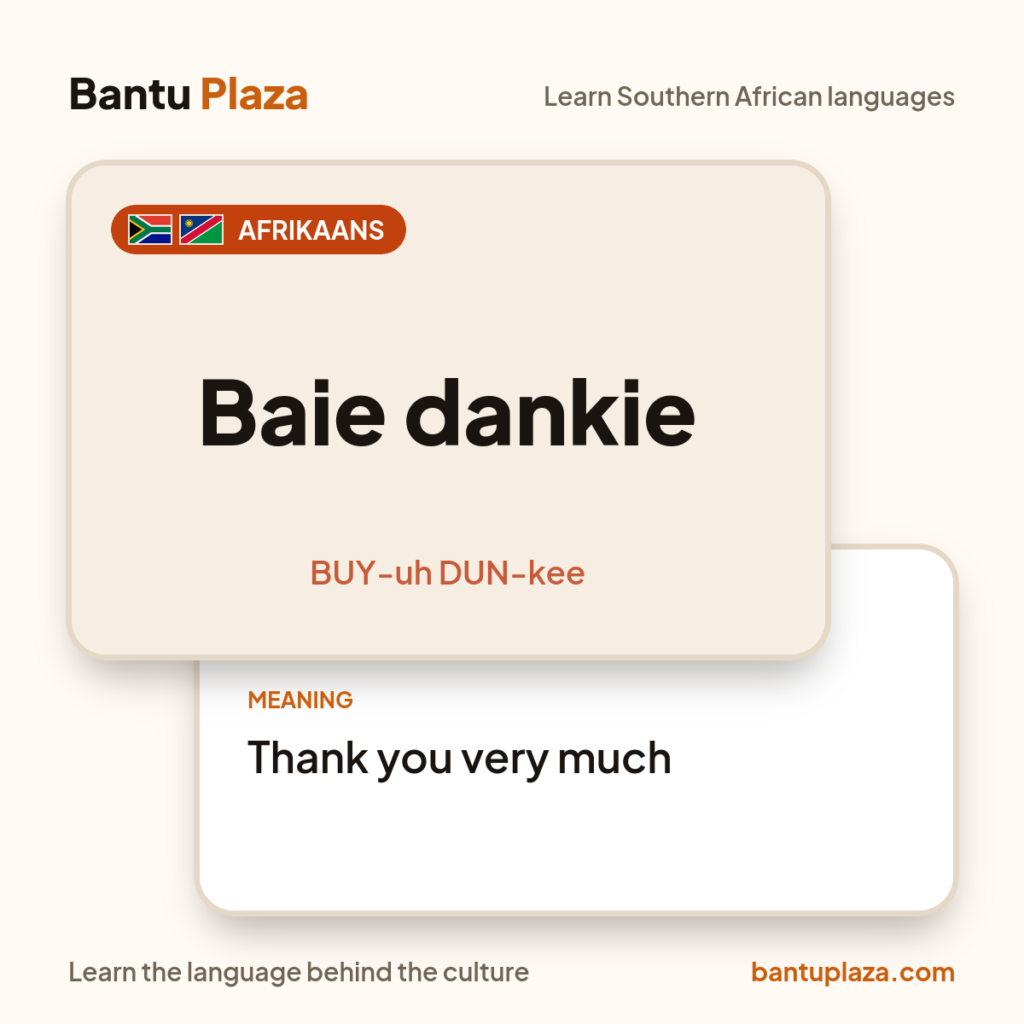
| Baie dankie | thank you very much | BUY-uh DUN-kee |
| Welkom | welcome (the w sounds like an English v) | VEL-kom |
| Totsiens | goodbye | tot-SEENS |
| Praat jy Afrikaans? | Do you speak Afrikaans? | praht yay af-ree-KAHNS |
| Ek praat ‘n bietjie | I speak a little | ek praht uh BEE-kee |
In everyday conversation
The two lines every learner needs first:
- Praat jy Afrikaans? Do you speak Afrikaans?
- Ek praat ‘n bietjie. I speak a little.
And when someone switches languages to help you, Baie dankie goes a long way.
Frequently asked questions
Who speaks Afrikaans the most in South Africa?
According to Census 2022, 72.6% of coloured South Africans speak Afrikaans most often at home, and by our estimate from the published percentages they are the largest group of Afrikaans home speakers.
Is Afrikaans dying out?
Its share of home speakers fell from 14.5% in 1996 to 10.6% in 2022, but Stats SA reports that the number of Afrikaans speakers grew by more than 700,000 over the same period.
Which province has the most Afrikaans speakers?
The Northern Cape has the highest share, with 54.6% of people speaking Afrikaans most often at home, ahead of the Western Cape at 41.2%.
What surprised you?
Which of these facts did you not expect, and whose Afrikaans did you grow up hearing? You can read the figures yourself in Stats SA’s Cultural Dynamics in South Africa report, or read our story Heritage Day: from Shaka Day to Braai Day.
Our Afrikaans hub has lessons at every level, and the Afrikaans Complete Language Pack (A1 to C2) takes you from your first words to fluency. Hear these words in the free 5-minute Afrikaans lesson, or book a trial with an Afrikaans tutor.
Quick check
Did you already know the word "Baie dankie"?
Want to understand more than the translation?
Learn the language behind the culture.
Newsletter
Get one culture story a week
New stories, a word to try and a free lesson idea. No spam, unsubscribe anytime.

Join the conversation
Question for you Which of these facts did you not expect, and whose Afrikaans did you grow up hearing?
Do you know this tradition, a different version of it, or the word for it in another language? Share it below.