
Heading to Bulawayo? Try a Free 5-Minute Ndebele Lesson
Five minutes of Ndebele greetings will change how people respond to you. Here is what you will learn in our free lesson.
Bulawayo is the main city of Zimbabwean Ndebele country. You can get by in English, and plenty of people will switch for you. But start a conversation in Ndebele and you will notice the difference in the first few seconds: a smile, a laugh, a question about where you learnt it. If you want to learn Ndebele before you go, our free five-minute lesson is the place to start.
Learn Ndebele in five minutes: what you will cover
How to greet one person, or a group
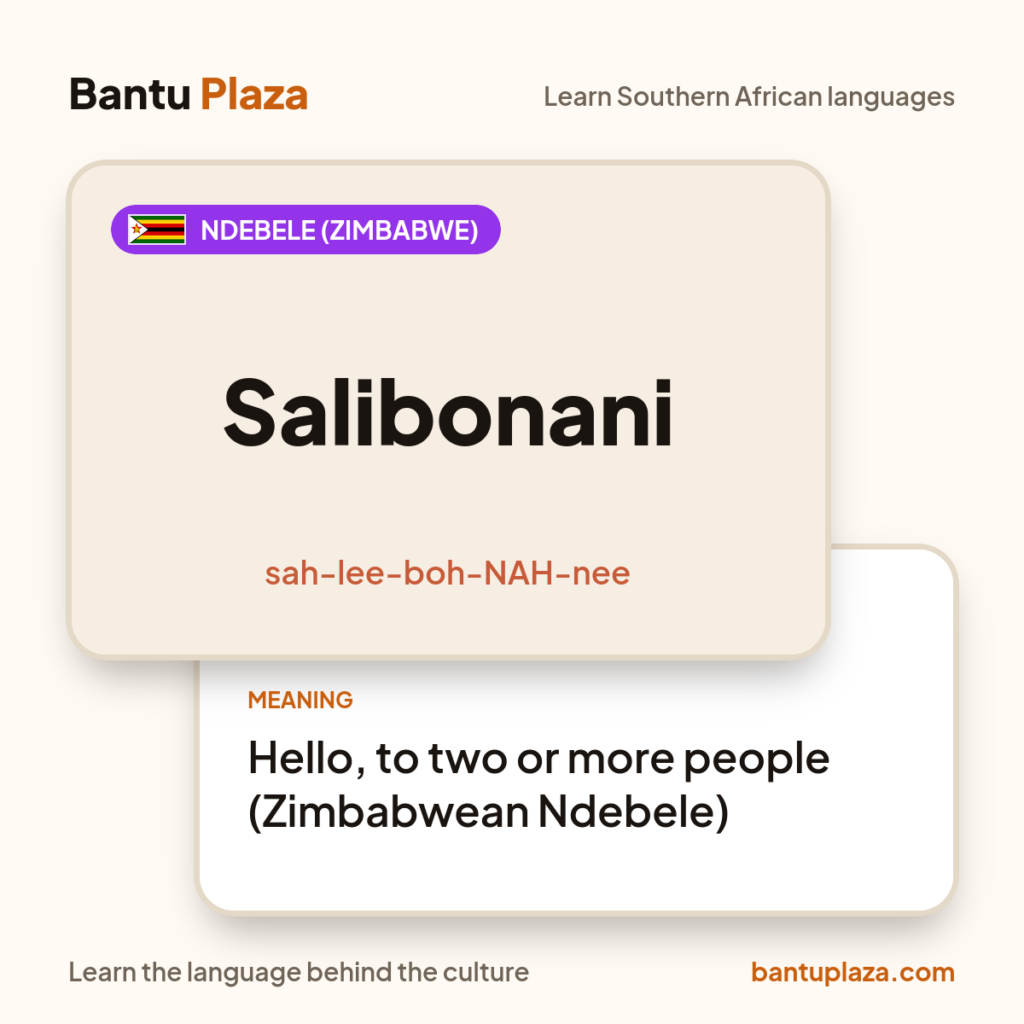
Ndebele changes the greeting depending on how many people you address. Say Sakubona to one person and Salibonani to two or more. If you know isiZulu, notice the change: Sawubona becomes Sakubona in Zimbabwean Ndebele, and Sanibonani becomes Salibonani.
How to ask and answer “how are you?”
Ask one person Unjani? and the usual reply is Ngiyaphila, ngiyabonga: I am well, thank you. To a group, the question becomes Linjani?
How to shop politely
Yimalini? asks how much something is. To ask for something, lead with Ngicela, please may I have: Ngicela amanzi means water, please.
How to say goodbye properly
Ndebele has two goodbyes, depending on who is leaving. Hamba kuhle means “go well”, said to the person leaving. Sala kuhle means “stay well”, said to the person staying.
Words to know
| Ndebele | Meaning | Say it like |
|---|---|---|
| Sakubona | hello, to one person | sah-koo-BOH-nah |
| Salibonani | hello, to two or more people | sah-lee-boh-NAH-nee |
| Unjani? | how are you? (to one person) | oon-JAH-nee |
| Ngiyaphila, ngiyabonga | I am well, thank you | ngee-yah-PEE-lah, ngee-yah-BOH-ngah |
| Yimalini? | how much is it? | yee-mah-LEE-nee |
| amanzi | water | ah-MAH-nzee |
| Hamba kuhle | go well, to the one leaving | HAH-mbah KOO-shleh |
| Sala kuhle | stay well, to the one staying | SAH-lah KOO-shleh |
The “hl” in kuhle is not an h followed by an l. It is a breathy “shl”, made by pushing air over the sides of the tongue.
In everyday conversation: a Bulawayo market stall
Here is how those pieces sound in a short exchange. Read it aloud twice and you have most of the lesson already.
You: Sakubona! Unjani?
Vendor: Ngiyaphila, ngiyabonga.
You: Ngicela amanzi. Yimalini?
Vendor: (tells you the price)
You: Ngiyabonga. Sala kuhle!
Vendor: Hamba kuhle!
Notice who says which goodbye. You are leaving, so you tell the vendor to stay well, and the vendor wishes you a good trip. Getting that the right way round is one of those small details people notice.
How the lesson works
- It takes about five minutes.
- Every word comes with a say-it-like guide, so you are not guessing how to pronounce it.
- It is free.
We teach Zimbabwean Ndebele, the language of Matabeleland and Bulawayo, and we are specific about that because the name Ndebele is used for more than one group in the region, as a University of Pretoria doctoral study on the Ndebele discusses.
Quick facts
- Bulawayo is the main city of Zimbabwean Ndebele country.
- Sakubona greets one person; Salibonani greets two or more.
- Hamba kuhle is said to the person leaving, Sala kuhle to the person staying.
- Zimbabwean Ndebele is close to isiZulu: Sawubona becomes Sakubona.
Frequently asked questions
How do you say hello in Ndebele?
Say Sakubona (sah-koo-BOH-nah) to one person and Salibonani (sah-lee-boh-NAH-nee) to two or more people.
How do you say thank you in Ndebele?
Say Ngiyabonga. For a warmer thank you very much, say Ngiyabonga kakhulu.
Can I learn Ndebele for free?
Yes. Our free lesson takes about five minutes and covers greetings, asking how someone is, shopping phrases and the two goodbyes.
Before you go
If you have been to Bulawayo, what is the one phrase you wish you had learnt before your first visit? If you already speak isiZulu, read Learn isiZulu and you will understand a lot in Bulawayo, and for the bigger picture see Myth vs Fact: Ndebele and chiShona in Zimbabwe.
When the first five minutes feel easy, our Ndebele hub and the Ndebele: Complete Language Pack (A1 to C2) take you much further. For now, start the free 5-minute Ndebele lesson and say your first Sakubona.
Sources
Quick check
Did you already know the word "Salibonani"?
Salibonani sah-lee-boh-NAH-nee
Hello, to two or more people (Zimbabwean Ndebele)
Learn more Ndebele words freeWant to understand more than the translation?
Learn the language behind the culture.
Newsletter
Get one culture story a week
New stories, a word to try and a free lesson idea. No spam, unsubscribe anytime.

Join the conversation
Question for you If you have been to Bulawayo, what is the one phrase you wish you had learnt before your first visit?
Do you know this tradition, a different version of it, or the word for it in another language? Share it below.