
Learn isiZulu and You Will Understand a Lot in Bulawayo
isiZulu and Zimbabwean Ndebele are close relatives. An isiZulu learner gets a head start in Bulawayo, but not a free pass.
If you have learnt some isiZulu and you land in Bulawayo, something pleasant happens. People greet you, and you understand them. Then someone offers you amazambane, and you get groundnuts instead of potatoes. Welcome to the close, and occasionally confusing, relationship between isiZulu and Ndebele as it is spoken in Zimbabwe.
Why isiZulu and Ndebele are so close
Zimbabwean Ndebele, the language of Matabeleland and Bulawayo, traces back to the followers of Mzilikazi, who left Zululand in the 19th century and eventually settled in what is now Zimbabwe. Linguists group both isiZulu and Zimbabwean Ndebele among the Nguni languages. Bantu Plaza’s Ndebele course describes the language as very close to isiZulu, and that closeness is exactly what an isiZulu learner notices first.
The sound patterns to listen for
The biggest shifts are regular, which makes them easy to learn:
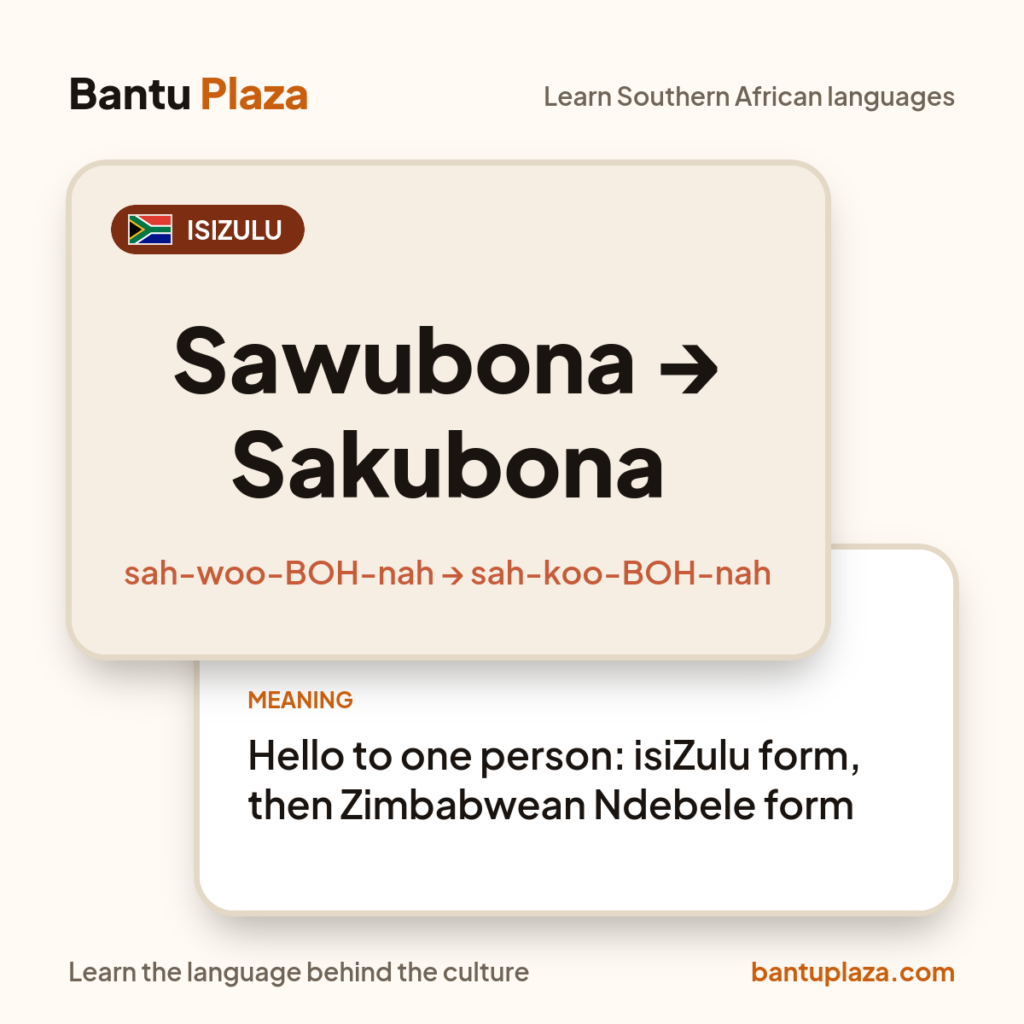
- wu becomes ku. isiZulu Sawubona (hello, to one person) is Ndebele Sakubona, said sah-koo-BOH-nah.
- ni becomes li. isiZulu Sanibonani (hello, to many) is Salibonani. isiZulu Ninjani? (how are you, to many) is Linjani?
- na becomes la. isiZulu nawe (and you) is Ndebele lawe.
Once your ear catches those, whole sentences click into place.
Where the head start ends
Close relatives still have their own vocabulary. Our favourite trap is food:
- In Zimbabwean Ndebele, amagwili means potatoes and amazambane means groundnuts or peanuts.
- In isiZulu, amazambane means potatoes.
The staple is different in name too. The thick maize porridge at the centre of a Bulawayo meal is isitshwala, usually eaten with isitshebo, a relish or stew.
What stays the same
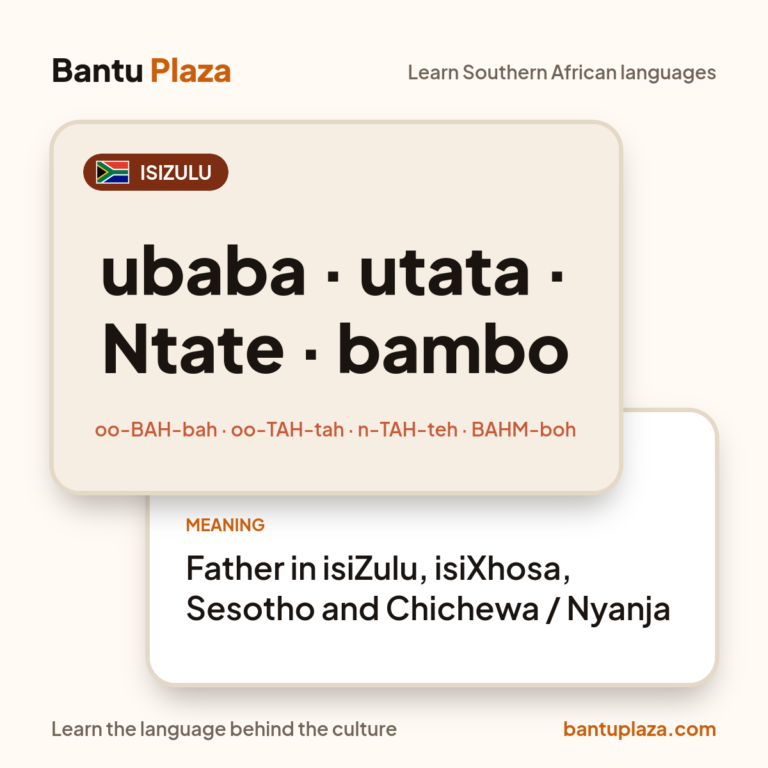
Ngiyabonga (thank you) and Uxolo (sorry, excuse me) work in both. So does Ngicela for “please, may I have”: Ngicela amanzi, water please.
Words to know
| isiZulu | Zimbabwean Ndebele | Meaning | Say it like |
|---|---|---|---|
| Sawubona | Sakubona | hello, to one person | sah-woo-BOH-nah / sah-koo-BOH-nah |
| Sanibonani | Salibonani | hello, to many | sah-nee-boh-NAH-nee / sah-lee-boh-NAH-nee |
| Ninjani? | Linjani? | how are you? (to many) | neen-JAH-nee / leen-JAH-nee |
| amazambane | amagwili | potatoes | ah-mah-zah-MBAH-neh / ah-mah-GWEE-lee |
| Ngiyabonga | Ngiyabonga | thank you | ngee-yah-BOHN-gah |
| amanzi | amanzi | water | ah-MAHN-zee |
One more to remember: in Bulawayo, isitshwala (ee-see-TSHWAH-lah) is the thick maize porridge, and isitshebo (ee-see-TSHEH-boh) the relish that goes with it.
How to use your isiZulu well in Zimbabwe
People will usually understand you, and many will appreciate the effort. Switching to the local forms, even just Sakubona and Salibonani, shows you know you are in Bulawayo, not Durban. That matters. Our Ndebele course adds that when you greet a group of neighbours, the plural Salibonani is the respectful choice.
Here is how a short exchange shifts:
- isiZulu: Sanibonani! Ninjani? Hello, everyone! How are you?
- Zimbabwean Ndebele: Salibonani! Linjani? Hello, everyone! How are you?
- Both: Ngiyabonga. Ngicela amanzi. Thank you. Water, please.
Key takeaways
- Zimbabwean Ndebele traces back to Mzilikazi’s followers, who left Zululand in the 19th century.
- Linguists group isiZulu and Zimbabwean Ndebele among the Nguni languages.
- Three regular shifts do most of the work: wu to ku, ni to li, na to la.
- Food words differ: amazambane is potatoes in isiZulu but groundnuts in Zimbabwean Ndebele.
- Ngiyabonga, Uxolo and Ngicela work in both.
Frequently asked questions
Can isiZulu speakers understand Ndebele?
To a large extent. Both are Nguni languages, and our Ndebele course notes that Zimbabwean Ndebele remains mutually intelligible with isiZulu. An isiZulu learner gets a head start in Bulawayo, but some words, especially food words, differ.
How do you say hello in Ndebele?
In Zimbabwean Ndebele, say Sakubona (sah-koo-BOH-nah) to one person and Salibonani (sah-lee-boh-NAH-nee) to more than one. The isiZulu forms are Sawubona and Sanibonani.
What does amazambane mean?
In isiZulu, amazambane means potatoes. In Zimbabwean Ndebele it means groundnuts or peanuts, and potatoes are amagwili.
Tell us
If you speak both, what is the funniest mix-up you have had between isiZulu and Ndebele? For another language that spans a border, read Xitsonga and Xichangana: A Language That Crosses the Limpopo. The history of the Ndebele in Zimbabwe is set out in Skhosana’s University of Pretoria thesis.
Build your base on our isiZulu hub or with the isiZulu: Complete Language Pack (A1 to C2). The quickest way to begin is to start a free 5-minute isiZulu lesson, or book a trial with an isiZulu tutor and practise the switch between Sawubona and Sakubona out loud.
Quick check
Did you already know the word "Sawubona → Sakubona"?
Sawubona → Sakubona sah-woo-BOH-nah → sah-koo-BOH-nah
Hello to one person: isiZulu form, then Zimbabwean Ndebele form
Learn more isiZulu words freeWant to understand more than the translation?
Learn the language behind the culture.
Newsletter
Get one culture story a week
New stories, a word to try and a free lesson idea. No spam, unsubscribe anytime.

Join the conversation
Question for you If you speak both, what is the funniest mix-up you have had between isiZulu and Ndebele?
Do you know this tradition, a different version of it, or the word for it in another language? Share it below.