
The isiXhosa Hymn Whose Melody Became Zambia’s Anthem
A choirmaster near Johannesburg wrote a hymn in 1897. Decades later its tune was carried across borders, including to Zambia.
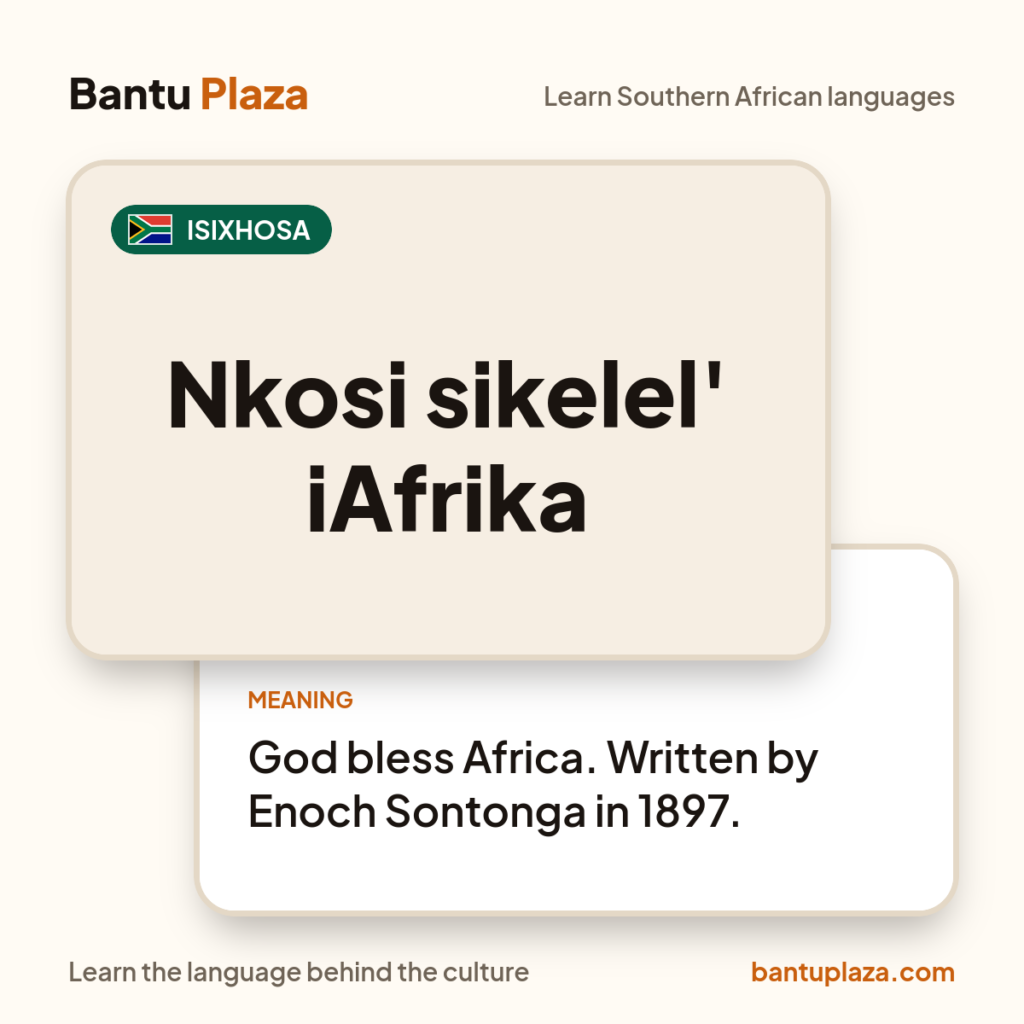
In 1896 a young teacher named Enoch Mankayi Sontonga took a post at a Methodist mission school in Nancefield, near Johannesburg. A year later he wrote a hymn for his choir, Nkosi Sikelel’ iAfrika, “God Bless Africa”. Its melody would travel far beyond that school, all the way to Zambia’s national anthem.
Who wrote Nkosi Sikelel’ iAfrika?
Sontonga was born around 1873 in Uitenhage, in what is now the Eastern Cape, and, according to South African History Online (SAHO), belonged to the Xhosa-speaking Mpinga clan of the Thembu. He trained at Lovedale Training College before being assigned to the Nancefield school, where he taught for nearly eight years.
He was the school’s choirmaster, and in 1897 he composed the opening stanzas of the hymn for his school choir. The South African government’s history of the anthem notes that the words of the first stanza were originally written in isiXhosa as a hymn. Sontonga died in Johannesburg on 18 April 1905, aged 32.
A school song that travelled
The hymn was first performed in public in 1899, at an ordination service. The choir of the Ohlange Institute, founded by John Langalibalele Dube, helped popularise it. The isiXhosa poet Samuel Mqhayi added further verses. It was recorded in London on 16 October 1923, with Sylvia Colenso on the piano, and by 1925 it had become the official song of the African National Congress.
The South African government’s history of the anthem adds another layer: a Sesotho version was published by Moses Mphahlele in 1942.
How Nkosi Sikelel’ iAfrika became Zambia’s anthem
SAHO notes that in the 1960s Zambia adopted the song as its national anthem, and that Tanzania and Zimbabwe also translated and adapted versions. Zambia uses Sontonga’s melody with its own words, known in English as “Stand and Sing of Zambia, Proud and Free”, and also sung in Bemba as “Lumbanyeni Zambia”.
So when Zambians stand for their anthem, including in Lusaka where Nyanja is the everyday lingua franca, the tune they sing was composed by an isiXhosa-speaking choirmaster in Gauteng. Zambia celebrates its independence on 24 October, which makes this a good week to listen to both anthems back to back.
Home again
In South Africa, the official anthem proclaimed in 1997 combines Nkosi Sikelel’ iAfrika with Die Stem. Its opening lines are in isiXhosa and isiZulu, followed by Sesotho, Afrikaans and English. On Heritage Day, 24 September 1996, Sontonga’s grave was declared a national monument; SAHO records that Nelson Mandela unveiled a memorial there and awarded him the Order of Meritorious Service.
Words to know
| Language | Meaning | Say it like |
|---|---|---|
| usapho (isiXhosa) | family, as in thina lusapho lwayo, “we, her children” | oo-SAH-poh |
| UThixo akusikelele (isiXhosa) | God bless you | oo-TEE-[x]oh ah-koo-see-keh-LEH-leh |
| isizwe (isiXhosa) | a nation, a people | ee-SEE-zweh |
| ilizwe (isiXhosa) | country | ee-LEE-zweh |
| sechaba (Sesotho) | community, nation | seh-CHAH-bah |
| banja (Nyanja) | family | BAHN-jah |
Listen for these lines
- Nkosi sikelel’ iAfrika: God bless Africa.
- thina lusapho lwayo: we, her children (her family).
- Morena boloka setjhaba sa heso (Sesotho): God protect our nation. In Lesotho spelling, nation is written sechaba.
Quick facts
- Enoch Sontonga composed Nkosi Sikelel’ iAfrika in 1897 for his school choir in Nancefield.
- It was first performed in public in 1899 and recorded in London in 1923.
- By 1925 it was the official song of the African National Congress.
- Zambia adopted the melody for its national anthem in the 1960s.
- South Africa’s combined anthem was proclaimed in 1997.
Frequently asked questions
Who composed Nkosi Sikelel’ iAfrika?
Enoch Mankayi Sontonga, a teacher and choirmaster at a Methodist mission school in Nancefield near Johannesburg, composed it in 1897.
Does Zambia’s national anthem use the same tune as Nkosi Sikelel’ iAfrika?
Yes. Zambia adopted the song in the 1960s and sings Sontonga’s melody with its own words, “Stand and Sing of Zambia, Proud and Free” in English and “Lumbanyeni Zambia” in Bemba.
What does Nkosi Sikelel’ iAfrika mean?
It means “God Bless Africa”. The first stanza was originally written in isiXhosa as a hymn.
Your memory
Where were you the first time you heard Nkosi Sikelel’ iAfrika sung by a big crowd, and which country’s version was it? Read SAHO’s biography of Enoch Sontonga or the South African government’s history of the national anthem, and for more on the city where Nyanja is everyone’s common language, see Town Nyanja: how Lusaka made a language its own.
Our isiXhosa hub has lessons at every level, and the isiXhosa Complete Language Pack (A1 to C2) takes you from greetings to heritage. To sing along with understanding, start a free 5-minute isiXhosa lesson or book a trial with an isiXhosa tutor.
Quick check
Did you already know the word "Nkosi sikelel' iAfrika"?
Nkosi sikelel' iAfrika
God bless Africa. Written by Enoch Sontonga in 1897.
Learn more isiXhosa words freeWant to understand more than the translation?
Learn the language behind the culture.
Newsletter
Get one culture story a week
New stories, a word to try and a free lesson idea. No spam, unsubscribe anytime.
Join the conversation
Question for you Where were you the first time you heard Nkosi Sikelel' iAfrika sung by a big crowd, and which country's version was it?
Do you know this tradition, a different version of it, or the word for it in another language? Share it below.