Naming the Family in Sepedi: Mma, Tate and Koko
A short Sepedi lesson on family words, from mma and tate to rakgadi and malome, plus how to use them politely.
Family words are some of the most useful words in any language, and Sepedi family words also carry a lot of respect. Here is a short lesson you can work through in about five minutes, from mma and tate to rakgadi and malome.
Sepedi family words, step 1: the household
- lapa: family, home. Say LAH-pah.
- mma / mme: mother. Say MMAH / MMEH.
- tate: father. Say TAH-teh.
- batswadi: parents. Say bah-TSWAH-dee.
- ngwana / bana: child, children. Say NGWAH-nah / BAH-nah.
Step 2: The grandparents
- koko: grandmother. Say KOH-koh.
- rakgolo: grandfather. Say rah-KHOH-loh. The kg is a breathy sound from the back of the throat.
Step 3: Aunts and uncles are not all the same
This is where Sepedi gets more precise than English. Lexicographers Danie Prinsloo and Sonja Bosch, writing about Northern Sotho dictionaries, point out that the language distinguishes relatives by side of the family and by age:
- malome: your mother’s brother. Say mah-LOH-meh.
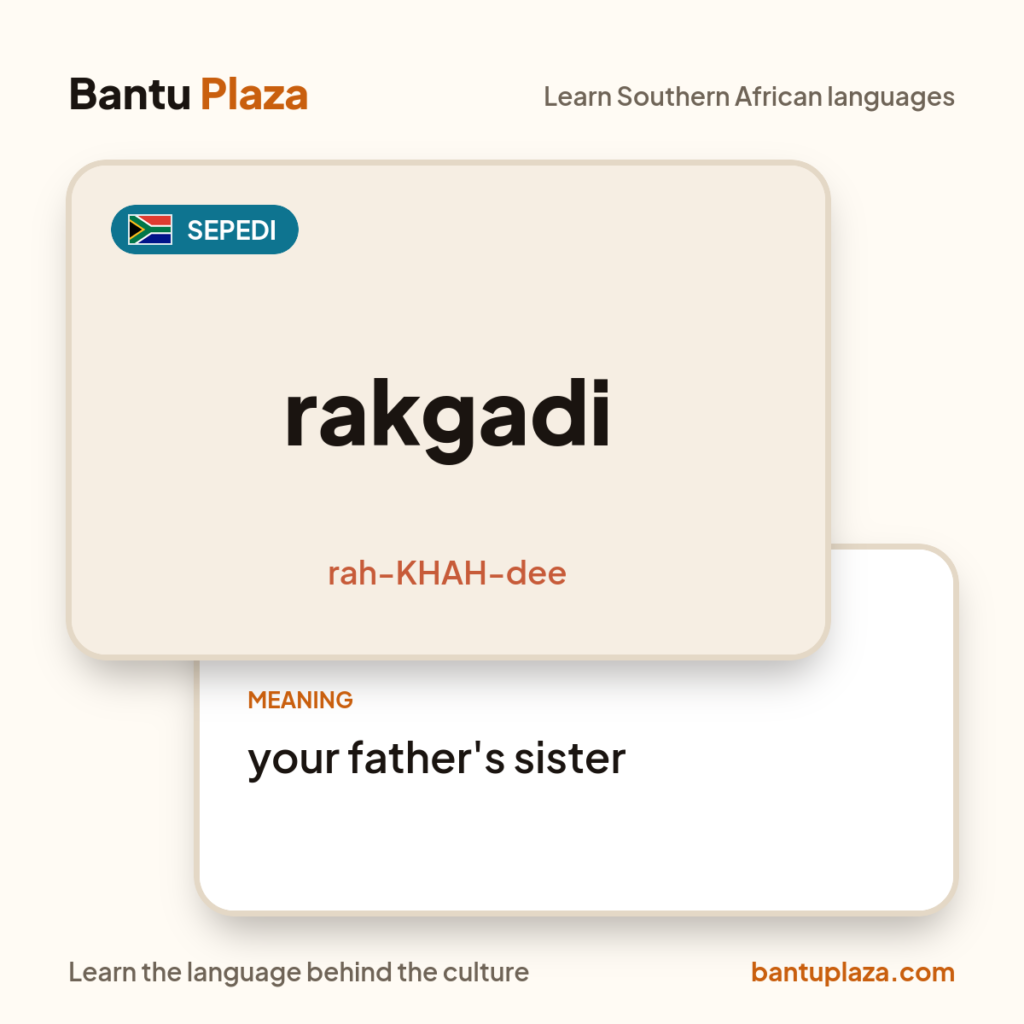
- rakgadi: your father’s sister. Say rah-KHAH-dee.
- ramogolo: your father’s older brother.
- rangwane: your father’s younger brother.
The same researchers note that Northern Sotho has 56 terms that a man and his wife use to refer to their parents, grandparents and great-grandparents. English has a handful. That gives you a sense of how carefully relationships are named.
Words to know: brothers, sisters and friends
Once you have parents and grandparents, add the people closest to your own age.
| Sepedi | Meaning | Say it like |
|---|---|---|
| buti | brother | BOO-tee |
| sesi | sister | SEH-see |
| kgaetšedi | sibling of the opposite sex (a man’s sister, a woman’s brother) | khah-eh-CHEH-dee |
| mogolwake | my older sibling | moh-ghoh-LWAH-keh |
| nnake | my younger sibling | NNAH-keh |
| motswala | cousin | moh-TSWAH-lah |
| mogwera | friend | moh-GHWEH-rah |
Kgaetšedi is only used between a brother and a sister, or between peers of the opposite sex.
Step 4: Use them politely
Family words double as titles, even for people outside the family. When you greet an older woman, add mma; an older man, tate. People your grandparents’ age are koko and rakgolo. Our course notes that a bare Dumela without a title can sound blunt, which is why Dumelang is the polite choice even with one person.
- Dumelang, mma. Hello, ma’am. (doo-meh-LAHNG, mmah)
- Thobela, tate. A respectful hello to an older man. (toh-BEH-lah, TAH-teh)
- Ke a leboga, koko. Thank you, grandmother. (keh ah leh-BOH-ghah, KOH-koh)
In everyday conversation
Here is a short scene at home from our Sepedi lessons:
- Dumelang, mma. Hello, mom.
- Ee, dumela. O tsogile bjang? Yes, hello. How did you wake up?
- Ke a leboga, mma. Ke kgopela meetse. Thank you, mom. May I have some water?
- Sepela gabotse, mma. Ke a go rata. Go well, mom. I love you.
Step 5: Test yourself
Cover the answers and try: What do you call your father’s sister? Your mother’s brother? How would you thank your grandfather?
Answers: rakgadi; malome; Ke a leboga, rakgolo.
Key takeaways
- Mma and tate mean mother and father, and work as respectful titles for older women and men.
- Koko is grandmother and rakgolo grandfather.
- Malome is your mother’s brother; rakgadi is your father’s sister.
- Northern Sotho has 56 terms a man and his wife use for their parents, grandparents and great-grandparents.
Frequently asked questions
How do you say grandmother in Sepedi?
Grandmother is koko, said KOH-koh. Grandfather is rakgolo, said rah-KHOH-loh.
What is the Sepedi word for aunt?
Your father’s sister is rakgadi (rah-KHAH-dee). Sepedi names relatives by side of the family, so your mother’s brother has his own word, malome.
How do you greet an elder in Sepedi?
Use Thobela with a title: Thobela, tate to an older man or Thobela, mma to an older woman. Dumelang is also polite, to one person or many.
Your family
Which relative in your family has a special title that visitors always get wrong? For the research behind step 3, see Prinsloo and Bosch’s Euralex paper on Northern Sotho dictionaries, and read why the language has more than one name in Sepedi or Sesotho sa Leboa?
Keep going with the free 5-minute Sepedi lesson, which has a whole section on family and home. You can find more on our Sepedi language page, and the Sepedi Starter Pack takes these words further, from greetings to everyday conversation.
Sources
Quick check
Did you already know the word "rakgadi"?
Want to understand more than the translation?
Learn the language behind the culture.
Newsletter
Get one culture story a week
New stories, a word to try and a free lesson idea. No spam, unsubscribe anytime.

Join the conversation
Question for you Which relative in your family has a special title that visitors always get wrong?
Do you know this tradition, a different version of it, or the word for it in another language? Share it below.