
Bailundo: The Town That Began as an Umbundu Kingdom
Today Bailundo is a small town in Angola's central highlands. Around 1700 it was the heart of Mbailundu, a powerful Umbundu-speaking kingdom.
In the middle of the town of Bailundo, in Angola’s central highlands, a huge metal statue stands in a traffic circle. It shows Ekuikui II, who ruled the kingdom of Mbailundu from 1876 to 1893. The town’s name is a reminder that before it was a town, it was a kingdom.
Bailundo history: a kingdom in the highlands
According to Shana Melnysyn’s 2019 article in the South African history journal Kronos, both oral histories and archival evidence suggest Mbailundu emerged as a political power around 1700. Oral tradition says its first ruler was a rifle-toting hunter who came from the north-west, from what is now Kwanza Sul province.
Mbailundu was one of several Umbundu-speaking kingdoms in Angola’s central highlands. Its rivals and neighbours included Viye and Wambu, the name behind today’s Huambo. Kronos describes Wambu as less powerful than Mbailundu but even more resistant and elusive. Ruling families organised large trade caravans that crossed the interior of Angola, and the kingdoms fought each other as well as the Portuguese.
The seat of royal power was the ombala, the royal capital or court. Mbailundu’s ombala stood on a rocky outcrop known locally as Halavala, above the later colonial fort.
Between trade and conquest
Mbailundu officially became a vassal of the Portuguese crown in the 1770s, but the Kronos article describes the relationship as explosively unstable, with frequent revolts. The balance shifted in the late 19th century. Ekuikui II let Portuguese traders settle near his capital and even wrote to the colonial government asking for a Portuguese captain to be stationed permanently at Bailundo. In rivalry with neighbouring Viye, he helped the Portuguese against that kingdom. After Viye’s defeat in 1890, Mbailundu dominated trade in the highlands.
It did not last. A Portuguese fort was built at Bailundo in 1895, and in April 1902 Mbailundu rose against encroaching colonial rule. The uprising, known as the Bailundo War of 1902 to 1903, was put down, and the kingdom lost its political and economic independence.
Remembered in Umbundu
Part of what we know comes from a remarkable document. A manuscript called Chronicles of Bailundo, written in Umbundu and kept in the archives of an American missionary board at Harvard University, records lists of rulers, court customs and stories of wars with Viye. A study of the Chronicles of Bailundo in the journal Africa, published by Cambridge University Press, examines it in detail.
Today, as the Kronos article “Mbailundu remembered” notes, Mbailundu remains a centre of Ovimbundu identity, and its history is still interpreted in different, sometimes competing, ways. The statue of Ekuikui II was erected in 2010 as part of celebrations of Angola’s 35th year of independence, and dedicated in a ceremony led by the Minister of Culture.
Words to know
| Umbundu | Meaning | Say it like |
|---|---|---|
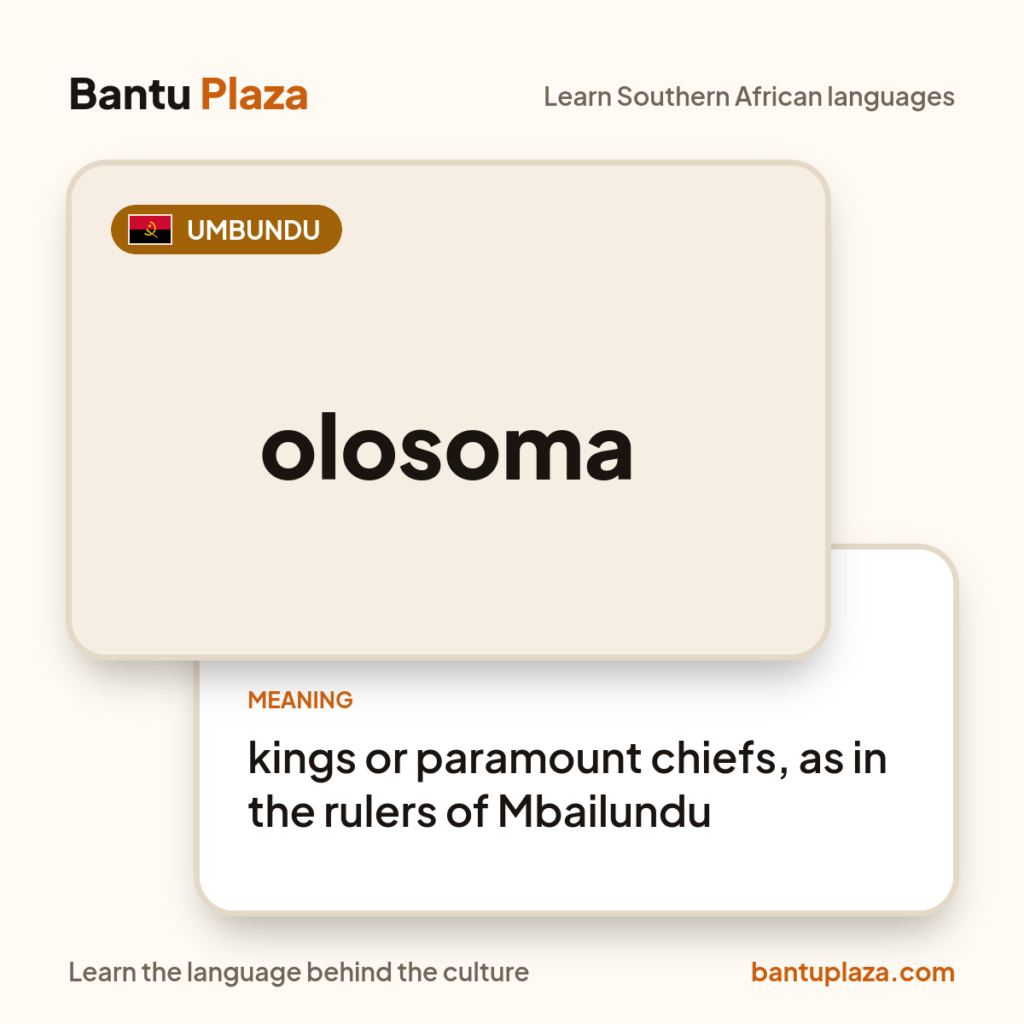
| olosoma | usually translated as “kings” or paramount chiefs | |
| ombala | the royal capital or court | |
| Kalunga! | hello, to one person, at any time of day | kah-LOON-gah |
| ofeka | country, land | oh-FEH-kah |
| olupale | town, city | oh-loo-PAH-leh |
| imbo | village | EEM-boh |
| onduko | name | ohn-DOO-koh |
Kalunga is the word you will use every day. The reply depends on who answers: men say Kuku, women say Kawe.
In everyday conversation
Place names turn up in the most ordinary talk. In our lessons, two people meeting for the first time say where they live:
- O kala pi? Where do you live?
- Ndi kala ko Wambu. Ove hẽ? I live in Huambo. And you?
- Ndi kala ko Kuito. I live in Kuito.
Notice that Huambo is still Wambu in Umbundu, the same name as the old neighbouring kingdom.
Quick facts
- Mbailundu emerged as a political power around 1700, according to oral and archival evidence.
- Ekuikui II ruled from 1876 to 1893, and Mbailundu dominated highland trade after Viye’s defeat in 1890.
- A Portuguese fort was built at Bailundo in 1895, and the kingdom lost its independence after the 1902 uprising.
- The Chronicles of Bailundo, written in Umbundu, are kept in missionary archives at Harvard University.
- The statue of Ekuikui II was erected in 2010 for Angola’s 35th year of independence.
Frequently asked questions
Where is Bailundo?
Bailundo is a town in Angola’s central highlands. It grew from Mbailundu, one of several Umbundu-speaking kingdoms in the region.
Who was Ekuikui II?
Ekuikui II ruled Mbailundu from 1876 to 1893. He allowed Portuguese traders to settle near his capital and helped the Portuguese against the rival kingdom of Viye, and a large statue of him now stands in Bailundo.
What does olosoma mean in Umbundu?
Olosoma is the Umbundu term usually translated as “kings” or paramount chiefs. That usual translation is noted in the Cambridge study of the Chronicles of Bailundo.
Over to you
Is there a town near you whose name began as a kingdom, a chief or a clan? What story does the name carry? For a gentler way into the language, read our story on how to start Umbundu with a free 5-minute lesson.
Find out more about the language on our Umbundu hub. You can try Umbundu for free in five minutes, and when you want more, the Umbundu: Starter Pack (A1) covers greetings, family words and everyday phrases.
Quick check
Did you already know the word "olosoma"?
Want to understand more than the translation?
Learn the language behind the culture.
Newsletter
Get one culture story a week
New stories, a word to try and a free lesson idea. No spam, unsubscribe anytime.

Join the conversation
Question for you Is there a town near you whose name began as a kingdom, a chief or a clan?
Do you know this tradition, a different version of it, or the word for it in another language? Share it below.