Izithakazelo: Why You Might Greet Someone by Their Clan Name
Hear someone called Njomane when their surname is Mhlongo? That is their isithakazelo, a clan praise that carries a family's history.
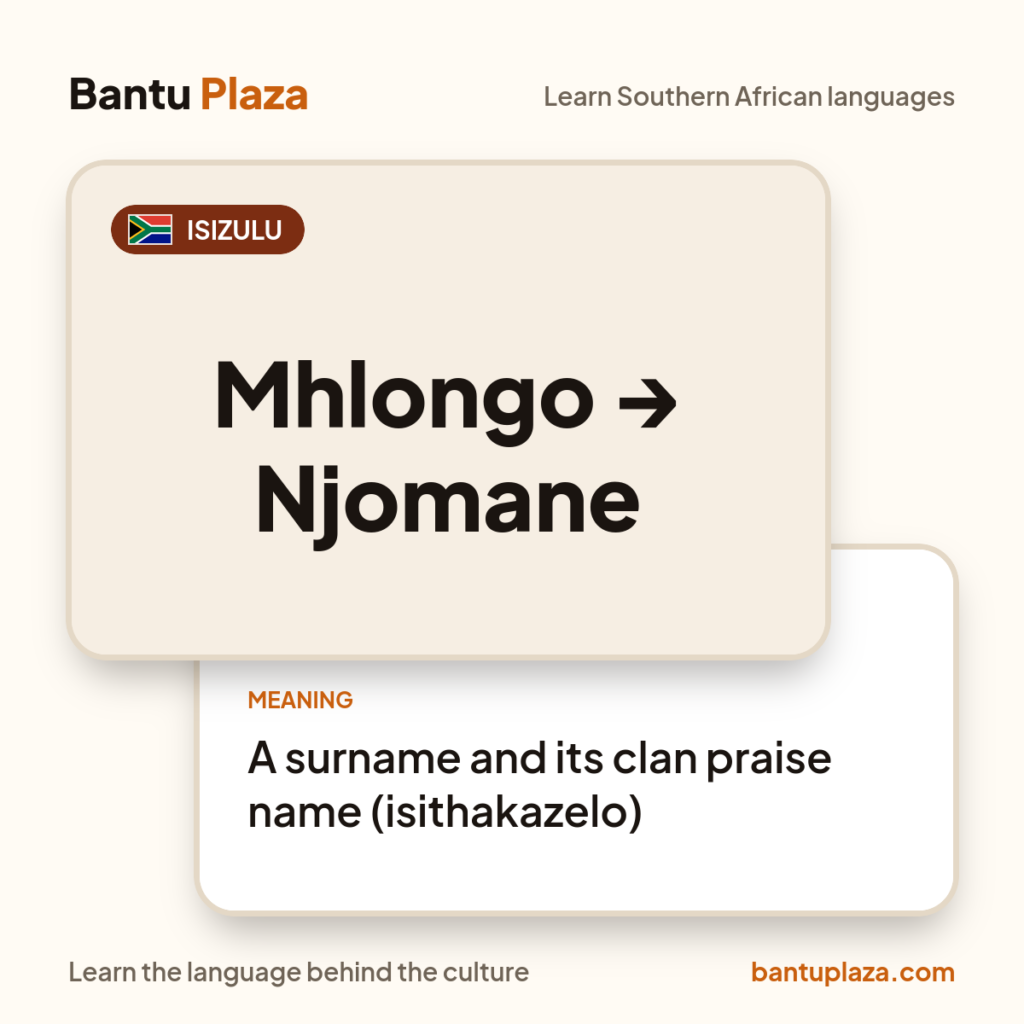
Imagine you meet someone called Mhlongo, and a moment later their friend calls them Njomane. Nobody has made a mistake. The friend has used the Mhlongo family’s isithakazelo, and in doing so has honoured them. Here is what izithakazelo are, where the examples come from, and how a learner can use them with care.
What are izithakazelo?
Izithakazelo (singular: isithakazelo) are clan praise names in isiZulu. The Ulwazi Programme, a community heritage project in eThekwini, draws on the work of the isiZulu scholar D.B.Z. Ntuli to explain them. Ntuli describes izithakazelo as a kind of praise, sometimes also called izithopho. Their purpose, according to researchers he cites, is to tell the history of a particular surname.
The article makes a striking point: almost nobody with an isiZulu surname can say they have no isithakazelo at all.
Examples of izithakazelo
The Ulwazi article gives three well-known pairs:
- Someone of the Mhlongo family may be called Njomane.
- Someone of the Ndlovu family may be called Gatsheni.
- Someone of the Maphumulo family may be called Mashimane.
The author, Nkosikhona Duma, ends by reciting the praises of his own Duma family, which run for several lines, beginning Ntenga, Mthombeni. Longer recitations are poetic: scholars note repetition, rhythm and rich imagery.
Why people use them
A surname tells you which family someone belongs to. An isithakazelo reaches further back, to the story of that family. Using it when you greet or thank someone is a way of recognising where they come from, and people often use izithakazelo when someone has done something worth praising.
Our advanced isiZulu lessons make the same connection: izithakazelo name a family’s lineage, and knowing your own is a deep mark of belonging. They sit alongside izibongo, the wider art of praise poetry, whose keeper is the imbongi, the praise poet.
A few cautions for learners
- Get the right one. Praises belong to specific families, and some surnames share praises while others do not. If you are unsure, ask politely.
- Variation is normal. Families may know different versions or longer and shorter forms.
- It is warm, not formal-only. You will hear izithakazelo among friends as well as at ceremonies.
Words to know
| isiZulu | Meaning | Say it like |
|---|---|---|
| isithakazelo | a clan praise name, a salutation | ee-see-tah-kah-ZEH-loh |
| isibongo | surname, clan name | ee-see-BOHN-goh |
| izibongo | praises, praise poetry | ee-zee-BOHN-goh |
| imbongi | a praise poet | eem-BOHN-gee |
| imvelaphi | origin, roots, where one comes from | eem-veh-LAH-pee |
| ukuhlonipha | to show respect | oo-koo-shloh-NEE-pah |
| Ngiyabonga | thank you | ngee-yah-BOHN-gah |
How to use it
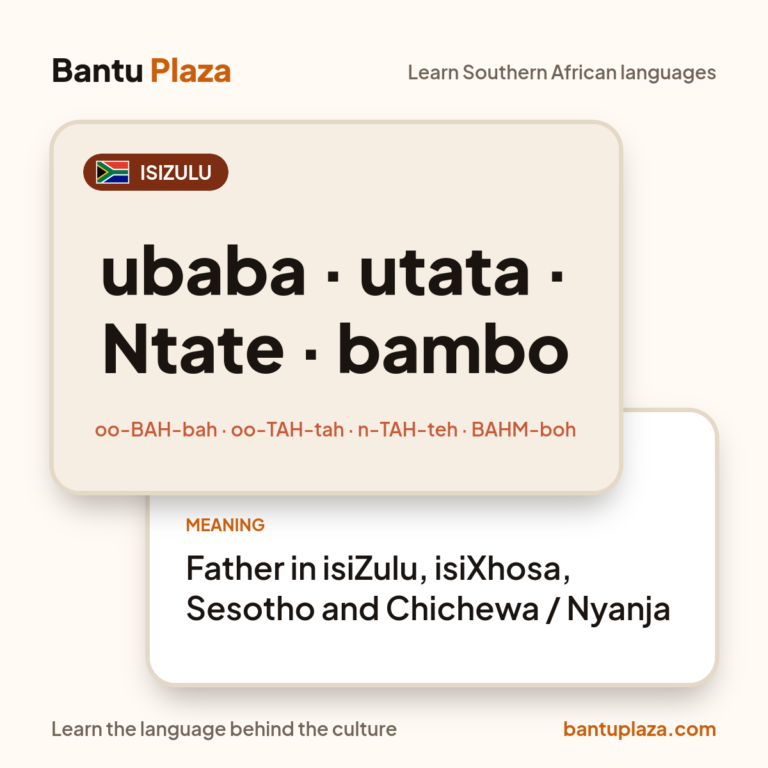
Before praises come greetings. With an elder, isiZulu speakers use respect words: baba (sir, father) for a man and mama (ma’am, mother) for a woman. Ngiyabonga is thank you. Add someone’s isithakazelo after it and your thanks lands very differently.
- Sawubona, baba. Hello, sir.
- Ngiyabonga kakhulu. Thank you very much.
- Ungalibali imvelaphi yakho. Don’t forget where you come from.
Quick facts
- Izithakazelo are isiZulu clan praise names, a kind of praise sometimes also called izithopho.
- Their purpose, in the research Ntuli cites, is to tell the history of a surname.
- Almost nobody with an isiZulu surname has no isithakazelo at all.
- Examples: Mhlongo and Njomane, Ndlovu and Gatsheni, Maphumulo and Mashimane.
Frequently asked questions
What does izithakazelo mean?
Izithakazelo are clan praise names in isiZulu, a kind of praise that tells the history of a particular surname. The singular is isithakazelo.
What is the isithakazelo for Mhlongo?
The Ulwazi Programme gives Njomane as the praise name for someone of the Mhlongo family. Families may know longer or different versions, so it is always fine to ask.
When do people use izithakazelo?
People use them when greeting or thanking someone, to recognise where that person comes from, and often when someone has done something worth praising. You will hear them among friends as well as at ceremonies.
Share yours
What is your isithakazelo, and do you know the story behind it? You can read the Ulwazi Programme’s article on izithakazelo in full, or see how names and greetings shift across a border in Learn isiZulu and You Will Understand a Lot in Bulawayo.
Our isiZulu hub gathers the lessons from first greetings upward, and the isiZulu: Complete Language Pack (A1 to C2) reaches the praise and naming vocabulary of the advanced levels. Start a free 5-minute isiZulu lesson, or book a trial with an isiZulu tutor who can explain the etiquette of praises in your family’s context.
Quick check
Did you already know the word "Mhlongo → Njomane"?
Want to understand more than the translation?
Learn the language behind the culture.
Newsletter
Get one culture story a week
New stories, a word to try and a free lesson idea. No spam, unsubscribe anytime.
Join the conversation
Question for you What is your isithakazelo, and do you know the story behind it?
Do you know this tradition, a different version of it, or the word for it in another language? Share it below.