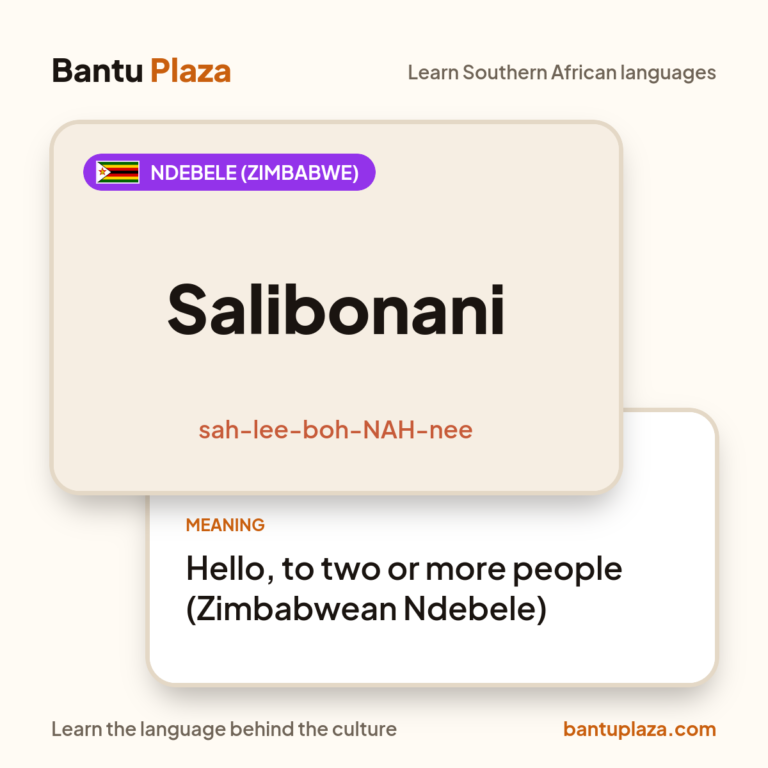
Heading to Bulawayo? Try a Free 5-Minute Ndebele Lesson
Five minutes of Ndebele greetings will change how people respond to you. Here is what you will learn in our free lesson.
Read story: Heading to Bulawayo? Try a Free 5-Minute Ndebele LessonDiscover Southern Africa
Food, names, proverbs, music and everyday life from the people who speak the languages. Read a story, join the conversation, then learn the words behind it.
Five minutes of Ndebele greetings will change how people respond to you. Here is what you will learn in our free lesson.
Read story: Heading to Bulawayo? Try a Free 5-Minute Ndebele LessonisiZulu and Zimbabwean Ndebele are close relatives. An isiZulu learner gets a head start in Bulawayo, but not a free pass.
Read story: Learn isiZulu and You Will Understand a Lot in BulawayoCensus 2022 data challenges three common assumptions about Afrikaans: who speaks it, where, and whether it is shrinking.
Read story: Myth vs Fact: Who Speaks Afrikaans at Home?A choirmaster near Johannesburg wrote a hymn in 1897. Decades later its tune was carried across borders, including to Zambia.
Read story: The isiXhosa Hymn Whose Melody Became Zambia’s AnthemLimpopo, Mpumalanga, Gauteng, Gaza? Tell us where your family's Xitsonga comes from and what sounds different to you.
Read story: Where Did Your Family’s Xitsonga Come From?Same word, same sound, same meaning. Which way you write it depends on where you went to school. Vote and tell us.
Read story: Poll: Molimo or Modimo? Which Sesotho Spelling Did You Learn?The Nyanja you hear on a Lusaka minibus is not quite the Nyanja in the textbook. Meet Town Nyanja, the city's everyday lingua franca.
Read story: Town Nyanja: How Lusaka Made a Language Its OwnCensus data shows Emakhuwa is the most spoken language in Mozambique, yet many people outside the country have never heard of it.
Read story: Emakhuwa: Mozambique’s Most Spoken LanguageKe a leboga, ngiyabonga, enkosi, ndaboka, inkomu. Thank you in twelve Southern African languages, with the stronger form for when you really mean it.
Read story: How to Say “Thank You” in 12 Southern African LanguagesMme, umama, amai, amayi, manana. The word for mother in eleven Southern African languages, and when it becomes a form of respect.
Read story: How to Say “Mother” in 11 Southern African LanguagesIn South Africa it is Xitsonga. In southern Mozambique many say Xichangana. Census data shows how big this cross-border language really is.
Read story: Xitsonga and Xichangana: A Language That Crosses the LimpopoMetsi, amanzi, mvura, madzi, maasi. One everyday word in thirteen Southern African languages, with a say-it-like guide for each.
Read story: How to Say “Water” in 13 Southern African Languages