How to Say ‘Father’ in Eight Southern African Languages
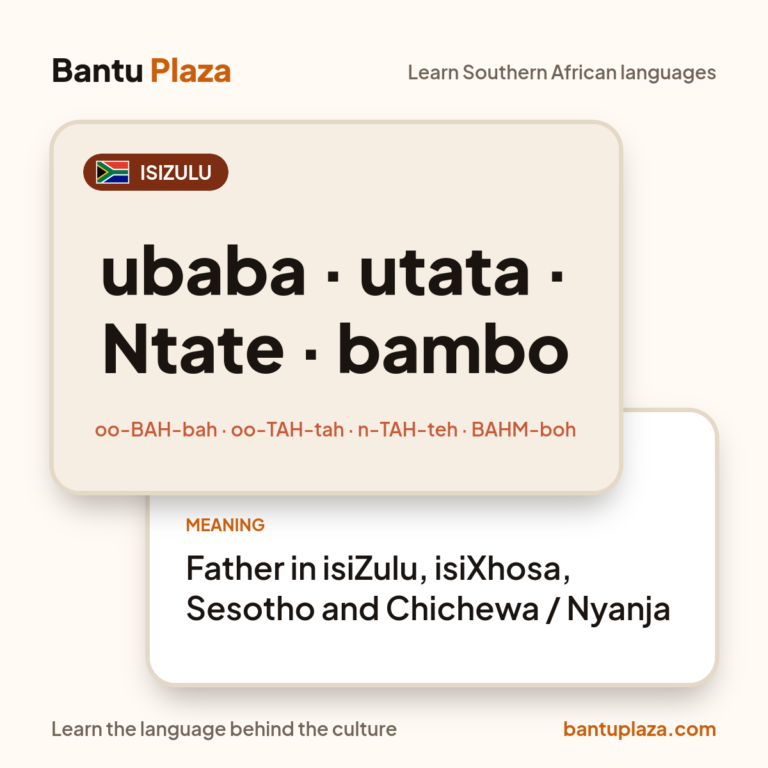
Baba, tata, rre, ntate, bambo, tatana, isia. One small word in eight languages, and what it tells you about respect.
Read story: How to Say ‘Father’ in Eight Southern African LanguagesSouth Africa (also Eswatini, Lesotho, Zimbabwe)
The food, names, greetings, sayings and everyday life behind isiZulu, the most widely spoken home language in South Africa (~12M first-language speakers). Each story links to words you can hear and practise in a free five-minute lesson.
Baba, tata, rre, ntate, bambo, tatana, isia. One small word in eight languages, and what it tells you about respect.
Read story: How to Say ‘Father’ in Eight Southern African LanguagesAn elephant with one tusk swallows a mother's children. So she packs maize and amasi, picks up her knife and goes to find them.
Read story: Unanana and the One-Tusked Elephant, a Zulu FolktaleIn isiZulu your father's brothers are also fathers, big and small, and your mother's brother is a 'male mother'. A guide to family words.
Read story: isiZulu Family Words: Baba, Mama and the Uncles Who Are Also ‘Father’Hear someone called Njomane when their surname is Mhlongo? That is their isithakazelo, a clan praise that carries a family's history.
Read story: Izithakazelo: Why You Might Greet Someone by Their Clan NameisiZulu and Zimbabwean Ndebele are close relatives. An isiZulu learner gets a head start in Bulawayo, but not a free pass.
Read story: Learn isiZulu and You Will Understand a Lot in BulawayoKe a leboga, ngiyabonga, enkosi, ndaboka, inkomu. Thank you in twelve Southern African languages, with the stronger form for when you really mean it.
Read story: How to Say “Thank You” in 12 Southern African LanguagesMme, umama, amai, amayi, manana. The word for mother in eleven Southern African languages, and when it becomes a form of respect.
Read story: How to Say “Mother” in 11 Southern African LanguagesMetsi, amanzi, mvura, madzi, maasi. One everyday word in thirteen Southern African languages, with a say-it-like guide for each.
Read story: How to Say “Water” in 13 Southern African LanguagesBefore 1995, 24 September was Shaka Day in KwaZulu-Natal. How it became Heritage Day, then Braai Day for some, is a story about compromise.
Read story: Heritage Day: From Shaka Day to Braai DayCulture guide
Compiled from the public sources listed under each section. Pronunciations are simple sound-it-out guides. Not yet reviewed by a native speaker: if something looks wrong, tell us.
Inkunzi isematholeni
Say it: een-KOON-zee ee-seh-mah-toh-LEH-nee
"The bull is among the calves"
Real leadership comes from living among and understanding those you lead, not standing apart from them.
Akukho lutho olungapheli
Say it: ah-KOO-koh LOO-toh oh-loon-gah-PEH-lee
"Nothing lasts forever"
Both hardship and good fortune are temporary: a comfort in difficult times, a caution in good ones.
Ukhala ngaso linye
Say it: oo-KAH-lah NGAH-soh LEE-nyeh
"He cries with one eye"
Said of someone who pretends to be sorry when they are not.
Umqombothi, a traditional beer brewed from maize and sorghum, is poured into a shared ukhamba vessel and drunk kneeling as a mark of respect. Two Zulu music traditions travelled the world from here: isicathamiya, soft a cappella harmony singing performed with careful, tiptoeing steps (cathama), and maskandi, guitar-driven folk music about love, politics and everyday life.
Say it: Umqombothi oom-qohm-BOH-teeIsicathamiya ee-see-kah-tah-MEE-yahMaskandi mah-SKAHN-dee
Sources: Wikipedia: Isicathamiya Β· Wikipedia: Maskandi
Ilobolo is the bride-wealth a groom's family gives the bride's family. It was historically paid in cattle and is more often paid in cash today. It is talked about as a relationship between two families rather than a purchase: a sign of respect, and of the groom's readiness to support a family.
The families agree the amount before the wedding. Many women describe ilobolo as recognition of their worth and upbringing, not a price placed on them.
Umkhosi Wokweshwama is the annual first fruits festival, held around the December solstice at the Enyokeni Royal Palace in Nongoma. By tradition no one eats from the new harvest until the king has tasted it first.
The festival was banned by colonial authorities after 1879 and revived in 1990. It continues today as a time of thanksgiving and renewal.
Sources: Wikipedia: Umkhosi Wokweshwama Β· The Ulwazi Programme: the first fruit ceremony
isiZulu is spoken in South Africa (also Eswatini, Lesotho, Zimbabwe). It is the most widely spoken home language in South Africa (~12M first-language speakers).
Yes. The free five-minute isiZulu lesson runs in your browser with no account needed. You learn a few real greetings and phrases from the Bantu Plaza isiZulu course.
Yes. Bantu Plaza lists isiZulu tutors for one-to-one online lessons. You can compare tutors, prices and open times on the Find a tutor page.
The isiZulu Complete Language Pack costs $49.99 and covers levels A1 to C2 of isiZulu, with interactive lessons you use inside your Bantu Plaza account.
Culture stories and guides for every language we teach.
Newsletter
New stories, a word to try and a free lesson idea. No spam, unsubscribe anytime.
Start with a free five-minute lesson in your browser. No account needed.